






A lesson from the ages
by Trey Nosrac
Modern harness races are distant relatives of the chariot races in the Circus Maximus. For more than a thousand years, the ancient races were part sporting event, part political theater, and part religious festival.
Racing at the Circus Maximus was chaotic, dangerous, and sometimes corrupt. There were riots, cheating, politics, and occasional violence. Yet for more than a thousand years, Romans could not get enough of it. The fans were rabid. The teams at the horse races became tribal identities. Fans talked incessantly about racing and wore their hearts on the sleeves of their togas and tunics.
What can we learn from these people and their favorite sport from long ago that applies to present-day harness racing? If you think nothing, I disagree. The Romans were very much like you and me – human nature does not change with the centuries. The Romans built an Empire filled with inventions, innovations, arts, and construction projects that still exist.
What were the principles of chariot racing in the Roman Empire that gave it such incredible power and longevity? Besides the fact that chariot drivers stood and harness horse drivers sit, what is different from our racing?
The biggest difference between Roman racing and modern harness racing isn’t speed, equipment, gambling, or attendance. The key difference is that Roman fans supported teams. In ancient Rome, the racing factions — Blues, Greens, Reds, and Whites — gave fans an identity. People didn’t root for a random driver or a random race; they belonged to a faction. They cheered for and against sporting foes. Their passion was passed down through generations. That sense of allegiance created an emotional connection that extended beyond any single race.
Without that kind of team identity, harness racing feels fragmented. Fans occasionally follow individual horses or drivers for short periods, but they do not feel that same loyalty. If modern racing could foster a greater sense of belonging — whether through teams, syndicates, or communities — a deeper engagement would help us grow and remain viable.
When we click on our devices tonight, we have several harness races available. Unless we own one of the horses in the race or have an attachment to one of the owners of the horse, who cares? It’s pretty simple: when people feel they’re part of something, they care more. Harness racing asks people to care about random races and horses they don’t own, then make a wager.
Today’s sport promotes races more than people. People follow people. Horses are wonderful creatures, but they barely move the needle of mass engagement. Even if you agree with this thesis, your reaction will be – “That’s not how this sport works,” or “Nice idea that cannot be done.”
Mention teams in harness racing, and eyes immediately begin to roll.
Why?
You can create teams at any level, for almost everything, and the experience will be improved. The LA Dodgers are a team in a league. I just watched 8-year-old girls play for their team in a community softball league. Do you want to bowl alone, golf alone, or watch your favorite football team scrimmage against teammates?
Teams can be created for harness racing. You do not even need to modify the current structure of racing one iota or pay a dime to attempt to create a team dynamic in our sport.
Shooting from the hip, I will create one for our sport in five minutes.
On April 1, the operator of this business plan, Chauncey T, has been working behind the scenes and has his ducks in a row for his product launch.
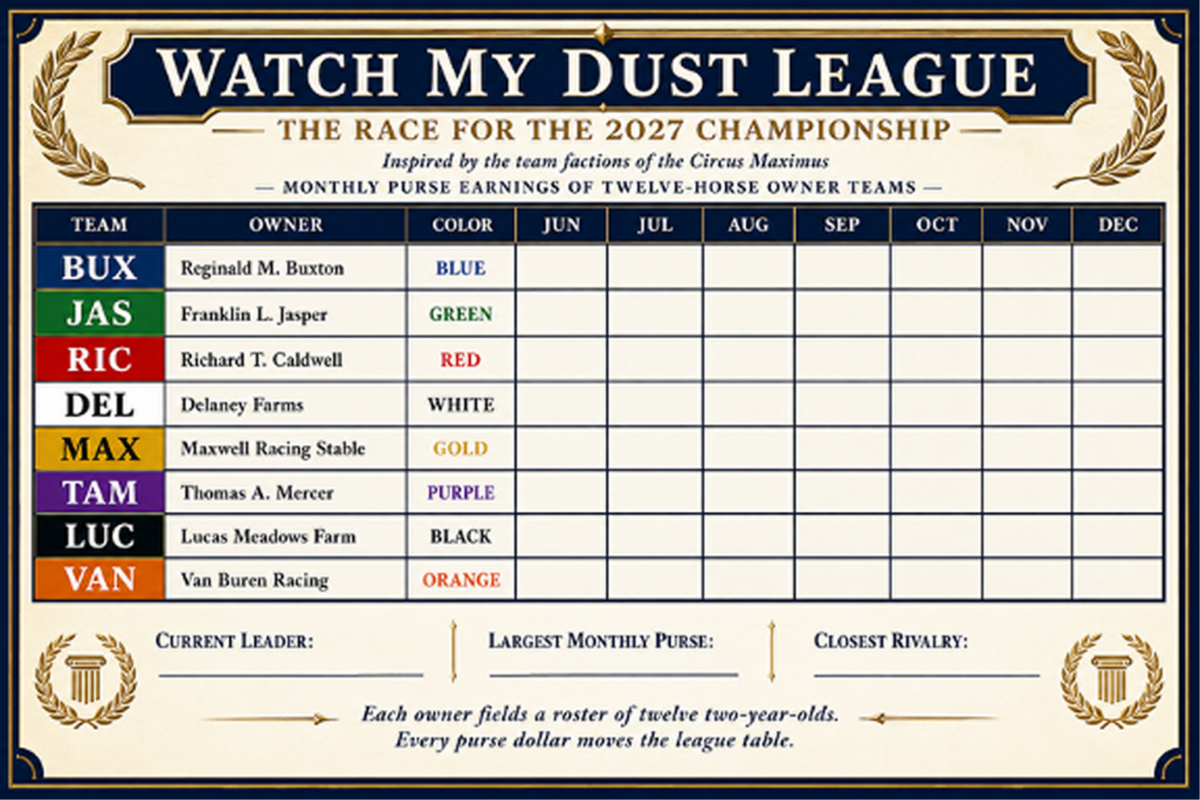
Chauncey found eight owners who will purchase multiple yearlings at next year’s auctions that will hopefully race in the 2027 season, and he gave them a call. Let’s name a couple of the big-deal, high-rolling owners – Franklin L. Jasper, Reginald M. Buxton. The owners pay nothing. Risk nothing. They don’t need to do much. They play for fun, pride, and maybe a cheesy trophy.
In March, as the 2-year-olds were in training, Chauncey asked the eight participating owners to select a dozen of their 2-year-olds to represent him in the new league. It does not matter what staking plan the owners have in mind, what trainers they have in mind, or where they are racing. The league is all about totaling purse money earned by the 12 nominated young horses.
These owners are saying to the other seven owners – my dozen selected horses will earn (in total) more than your dozen selected horses during calendar year 2027. Period. Simple.
Chauncey names the league the WMD (Watch My Dust) League.
The owners use subheadings for their dozen horses – BUX for Buxton horses, JAS for Jasper horses, etc.
The team rosters, consisting of a dozen 2-year-olds in training, are posted on April 1.
Wagering on the teams closes in 30 days, on May 1. The wagering is very simple. There are no fluctuating odds. None of the 96 horses can be replaced. No new horses can enter. There is no takeout in this model. Chauncey makes his money on the interest for holding the pot for six months.
In an eight-team league, a $1,000 supporter of the champion would collect $6,000, while a supporter of the runner-up would still receive $2,000 – twice his original investment. That is an attractive payoff structure that gives wagerers a reason to follow a team all season. As a player, you can use any method to choose your team. You can carefully study the yet-to-race 96 horses, choose a favorite color or name, use a dartboard or Ouija board – who cares? You just chose your team and wager what you want.
Would Trey play? Heck yes, I’d play. This league would be a massive improvement over losing a grand by daily paper cuts with high takeouts over a long season. I would not need to watch or wager on a single race that I don’t care a hoot about.
Here is the real benefit for our sport.
Anyone can download a free app. The app on your phone has the running scoreboard. Every time it dings or buzzes, that is your signal that in five minutes, a WMD race is going to post. This can be one of your dozen stables of horses, or it can be any one of the 80 opposing horses in the league. Ding ding ding. Buzz, buzz, buzz. You have something to watch and cheer for or against all season long.
I tell my pals about my team of horses. They start to follow my team. They put an app on their phone to check in on league races and standings. What a great way to learn the sport. What a great way to have fun. How many things can you name that a team dynamic would spice up the games: t-shirts, team songs, parties, chat rooms, memes, blah blah.
Now, how difficult was it to create a team concept? I could devise five more in an hour.
How much fun would that be to play?
What does it matter if a dozen or a million people pick a team and get an app?
Who loses?
Teams rule. The Romans understood that two thousand years ago. Fans want heroes, rivals, and bragging rights. Harness racing already has magnificent horses, courageous drivers, and generations of tradition.
What we need are teams.
Stay on top of all harness racing news.
Join the HRU mailing list, free.