




The Distant Dozen (Intro)
by Trey Nosrac
Welcome to the Distant Dozen. You know who you are. Nobody else does. You will remain incognito.
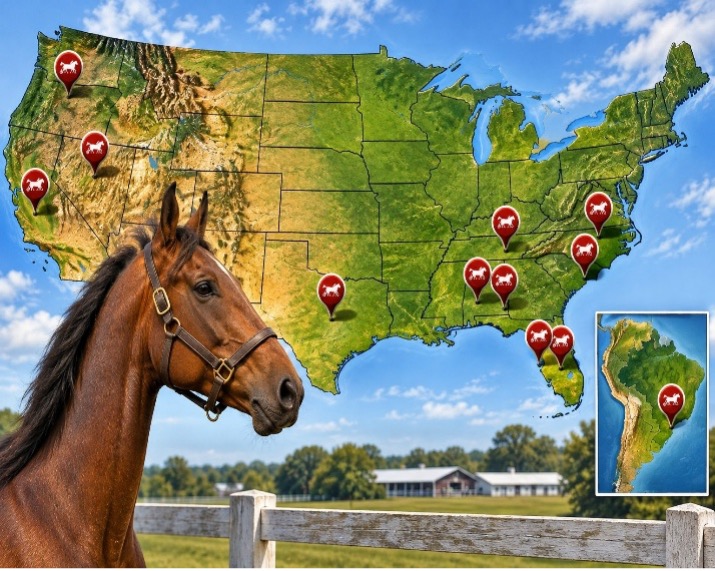
Your fellow conspirators are scattered across Nevada, Florida, North Carolina, California, Tennessee, Alabama, Texas, Oregon, South Carolina, Washington, with one expatriate in Brazil. These locations are hardly hotbeds of harness racing. Most of you have never seen a harness race and wouldn’t know a sulky from a shopping cart.
Perfect. We will go slowly and have fun. There will be visuals.
You agreed to participate in an experiment, and I intend to reward your recklessness. Should our baby horse grow into a solid competitor, your reward may be a microscopic sliver of the net earnings and perhaps some swag like a T-shirt and a cap.
No contracts. No financial risk. No obligations. No names. All that is required is your attention. This will be a real horse, but not an official partnership. Consider any rewards as gifts for your participation.
Those of us addicted to this fascinating sport have not had much success introducing harness racing to new people. We start with races, wagering, racing programs, and complicated terminology. This time, we will begin with a horse, a single horse with a unique personality.
The working premise is that maybe people need to care about a horse before they care about a horse race. Along the way, they will meet the people who care for the horse. We’ll let that horse tell the story and see whether 12 strangers become interested in what happens next.
Buying a yearling racehorse is an unusual exercise in optimism. We look at a young horse that has never raced, study the family, inspect legs, ask questions, write checks, and hope that after long months of practice, somewhere inside the animal is a competitive racehorse. Each baby horse is a story. Nobody knows how the story will develop.
Here’s a trivia-night word: anthropomorphism is the literary practice of giving animals human characteristics, including the ability to think, speak, and tell their own stories. It’s hardly a literary breakthrough. Anna Sewell did it in Black Beauty in 1877. Michael Morpurgo gave us another equine orator in War Horse in 1982. And Garth Stein let a dog named Enzo philosophize about human behavior in The Art of Racing in the Rain in 2008.
Our horse will be considerably less literate, young, inexperienced, bewildered, a bit flippant, and constantly eavesdropping on the human beings who hold the reins.
As usual, I have placed the cart before the horse. Over the next few weeks, I will scramble and purchase a partial interest in a yearling (a yearling is a 1-year-old horse). My preference is to find a horse that lives in Ohio and has a trainer and grooms who will be comfortable becoming part of the story.
In late January, our as-yet-unknown horse will introduce themself and begin telling their story via weekly posts on the HRU website. By late June of 2027, you might be racing for money and watching on your iPad.
Between those dates, anything can happen. The horse doesn’t know what’s coming. Neither do the Distant Dozen. And neither, as usual, does Trey.
Stay on top of all harness racing news.
Join the HRU mailing list, free.