





Travelling 80 years back in time to the very first Little Brown Jug
by John Berry
The date was Sept. 18, 1946.
The town of Delaware, OH, a tiny, sleepy haven whose population, according to the 1940 census was 8,944, was about to become the pacing capital of the United States for the day — make that all of North America for the day.
In fact, Delaware, OH, was on its way to become the capital of the entire world for the day.
Sandusky Street was the main business district and Curly Smart told me many years ago that the iconic Bun’s Restaurant and Bar was almost as famous as the Little Brown Jug had become.
The Village Diner had opened “not too long after the [Delaware County] fairgrounds had opened,” he said.
And for movie lovers, the Strand Theatre provided the “major entertainment” for the town.
But, now, Delaware, OH, was about to become known for “the greatest show on earth for the rapidly growing validity of the pacer.”
After the Jug Previews and the inaugural Little Brown Jug in 1946, the main thoroughfare had been transformed with travelers in mind as service stations and, eventually, motels were in place to host the automobile traffic along routes 23 and 42.
The attorney, Joe Neville, got things started years earlier by allegedly neglecting to decline an invitation for Grand Circuit dates, with the editor of the Delaware (Ohio) Gazette, Hank Thomson, gawking in disbelief after the news came over the Associated Press wire that would indicate Neville’s acceptance.
Neville’s now famous words, “Oh my heavens, I plumb forgot to send that telegram” of refusal, now have more than 80 years of history behind them and have turned the town of Delaware, OH, into one of the most important September sites in harness racing throughout the entire world.
Thomson earned the position of race secretary and, years later, remarked, “I’ll never forget the day he pulled me over and told me I was the new race secretary.
“I didn’t know a thing about horses and Joe knew it.
“I asked Joe ‘Why?’ and he said [with all of his 350 pounds jiggling up and down], “I figured we’d get all the publicity we needed from the Delaware Gazette!”
Thomson also said that Curly Smart was the most outstanding track superintendents in harness racing.
Smart also was one of the greatest horsemen to occupy a sulky.
With a record purse of $35,358, over $600,000 in today’s funds, iconic journalist Tom Gahagan of the Horseman and Fair World wrote “The Jug is now established as a great American classic.”
There were nine horses in this inaugural event — seven colts and two fillies — and it took four heats to determine the winner before a crowd of around 27,000.
Yet another highlight to this inaugural Little Brown Jug was the fact that Smart was the 11th hour choice to drive Ensign Hanover, entered by Castleton Farm.
Ensign Hanover was set to be handled by Sep Palin, who had warmed up the colt.
But Palin had suffered injuries in a mishap some days before and decided to put his colt in steadier hands.
This was no cakewalk for Ensign Hanover as veteran Tom Berry had a pair of entries, DeSota Hanover and Royal Chief.
Berry drove “DeSota” while 26-year-old Del Cameron took the Iines back of Royal Chief.
In a classic battle in the first heat, Cameron won over Smart as Royal Chief got the best of Ensign Hanover in what was described as a “sizzling” 2:02.3.
In the second heat, Smart was the photo finish winner with Ensign Hanover over Quick Trick.
The filly, His Lady, handled by Joe Hylan, just did hold off the late rally of Ensign Hanover to score in the third heat — 2:05.1 — with the three heat winners coming back for a deciding fourth heat.
In a classic fourth heat duel, Ensign Hanover sat in the pocket until just past the third station and just did nip His Lady in the final yards to grab the inaugural and official first edition of the Little Brown Jug.
Ohio Governor Frank Lausche was in the winner’s circle along with Castleton Farm’s Jimmie Johnson, owner of Ensign Hanover.
Fast-forward to 1965 and Smart proved that he was the greatest track superintendent in harness racing, just as Hank Thomson said.
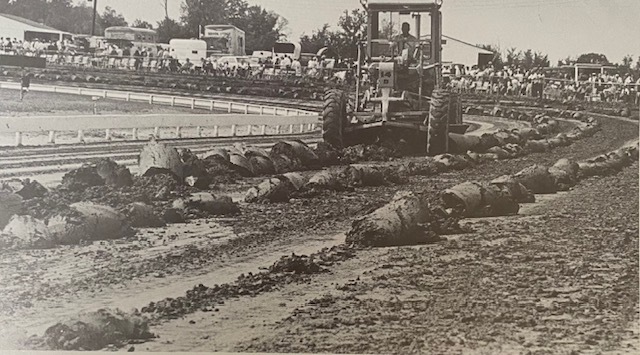
Delaware, OH, had been bombarded with storms beginning the previous afternoon leading up to “harness racing’s greatest event” with the track on Jug morning a sea of mud.
The storms were torrential leaving the famed half-mile oval a quagmire!
At around 9:30, it was still raining, but the forecast was for partial clearing.
Smart had two jobs that morning, the most important one being turning the quagmire into what would be a world record setting day, if that was, indeed, possible.
The other job was to get his entrant in the race, Tuxedo Hanover, ready for competition.
Smart told me that “getting the track ready — if possible — was the number one priority and that he would take care of the next one — or try to — on the racetrack.”
At around 10 a.m., Richard Downing, owner of Bret Hanover, was on his way to the Ervin barn and about the most optimistic thing he heard from Ervin was, “Well, it hasn’t been officially canceled.”
Then, like a miracle, the rain stopped and the sky began to brighten.
Smart and Thomson huddled and Thomson asked Smart, “What’s your verdict?”
Smart told Thomson to call in the County equipment and said, ”We’ll skin it.”
A miracle was about to unfold in Delaware, OH.
Trackmen Wray Byas, Lee Watson, Ted Ketcham, Jim Nolan, and others all went off on their own tangents with just about every earth-moving machine available.
Though post-time was delayed for around an hour, there were no complaints from the fans — about 41,200 of them — that were quickly filling the stands.
Would the track be off a second or two as the racing surface began to look like it was on its way to being good?
Not only good, it was lightning fast, after Smart and his crew performed the miracle of miracles in Delaware, OH.
Bret Hanover had conquered the most prestigious pacing event in harness racing, the Little Brown Jug, in straight heats, and in world record time, 1:57 and 1:57.2.
Tuxedo Hanover, handled by none-other than Smart, finished second in both heats.
The other entrants in this race were Rivaltime, G Lee Hanover, arch-rival Adios Vic, Scarlet Wave, and Skipper Jean.
Don Evans, one of the greatest harness racing writers in this sport, told me about another record he witnessed that day.
He said, “Curly Smart received the most thunderous and lengthy applause in history from the huge crowd as he returned to salute the judges at the end of the final heat. That man and his great crew turned a quagmire into a world record race course.
“And the crowd, all 40,000 or so, wanted to salute him for it.”
The atmosphere, the horses, the speed, and the French fries that hang over the side of the cup.
Most fans put salt or ketchup on them, but there’s always a taste of vinegar waiting for you if you prefer.
The Little Brown Jug, don’t miss it.
May The Horse Be With You!
Stay on top of all harness racing news.
Join the HRU mailing list, free.



