



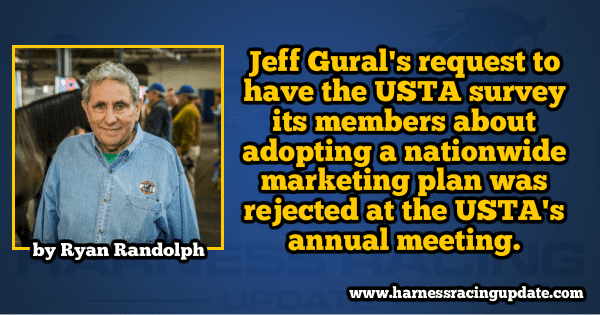



Gural baffled by USTA stance on his marketing plan
But USTA CEO Mike Tanner said Gural’s frustration may be misplaced.
by Dave Briggs
Meadowlands Racetrack owner Jeff Gural said he’s surprised the United States Trotting Association (USTA) acknowledged its members were supportive of diverting money toward a nationwide marketing plan for harness racing, but he’s frustrated with the USTA’s decision not to act on the matter as proposed by Meadowlands chief operating officer Jason Settlemoir.
A USTA News release about the Monday, March 12 closing session of the association’s annual meeting in Columbus, OH said the following:
“In the closing session, Jason Settlemoir (District 8) asked the board to consider polling USTA members as to whether or not they would approve of five per cent of purse funds from tracks with expanded gaming to be placed in a nationwide marketing fund. Ivan Axelrod, USTA chairman of the board, responded that yes, he thinks that if posed this question, most members would say yes to ‘spending other people’s money’ to market the sport. What comes next would be the challenge, since determining the means of obtaining the money, then determining who deployed the money and how the money would be utilized remained as questions too big to be answered, regardless of the results of a survey. ‘We know what the answer is going to be, so I think that would make our members more upset with us because we couldn’t do it, than by not asking at all,’ Axelrod said.”
Gural’s take?
“I think what they are saying is pretty sad. They are saying it’s too hard and it’s too much work for us to implement, so, screw it, we’ll just do nothing,” Gural said. “We all know what the end result is going to be… it’s not if, it’s when. It’s very frustrating, not to me because I’m 75, but anyone under 40 that thinks they have a long-term career in this business better go back to school and have a plan B because they are not… I guarantee that the founders of the Hambletonian Society would never approach it this way. They would look at it like they have an obligation to protect the members who are under 40.”
USTA CEO and executive vice-president Mike Tanner said, “it’s always worthwhile to market your sport and the product, (but) marketing needs to be defined and over the years that Jeff has been bringing the idea forward, the most detail that we’ve gotten is that we would get all this money and just hire a big marketing firm.
“All I’ve heard – and maybe Jeff has more details and we just haven’t seen them – is that we’ll raise all this money to create a national marketing fund and then we’ll give it to a big advertising agency or a big marketing firm and they’ll tell us what to do.”
Tanner stressed that he is not a USTA director, but his read on the directors’ reaction to the idea of a USTA survey of its members on the matter is that it is unnecessary.
“We’ve already done this. We did it with the Meadowlands back in 2012. There was a survey that Jeff paid for, that the USTA facilitated,” Tanner said. “It went out on USTA letterhead and envelopes even though it was Jeff’s survey.”
A USTA story on the subject from March 19, 2012 (full story here) said, “the results of a recent survey conducted by Tioga, Vernon and Meadowlands operator Jeff Gural was presented by USTA director and Tioga Downs executive Jason Settlemoir. The survey of USTA members in New York, Pennsylvania and Delaware asked if horse owners would be willing to divert one percent of purse money to improved drug testing and one-half of one percent to marketing efforts; the result showed an 84 and 87 percent “yes” response to the questions, respectively.”
All that is moot, anyway, said Tanner. He said the USTA does not have the power to redirect purse money to industry-wide initiatives.
“We don’t have the autonomy to take any purse money,” Tanner said. “That lies with the state racing commission and the horsemen’s organizations and that became very clear in the wake of that 2012 survey.
“There are laws, for example in Pennsylvania, that say you can’t use it for anything except ‘this and this’. It became clear to us that there were some major roadblocks there and I think there are people in the industry that think we are a central organizing body that has commissioner’s powers and we are not. We’re not at all.”
Tanner said the USTA leading the charge on an industry-wide after-care program called the Standardred Transition Alliance (STA) (see story pg 1) that is asking for an allocation of funds from existing industry money — similar to what Gural is asking for in his marketing strategy —is simply a case of backing a program with a better chance of success.
“As to why the USTA cannot go out into the industry to pursue 5 percent funding for marketing when it now has decided to go out into the industry in an effort to establish an aftercare program, my answer would be that the STA has a better chance of happening than does Jeff’s proposal, at least in the short term. The ‘ask’ is more modest, there’s a plan on the table, and there’s been vocal support for the idea from a diverse group of prominent industry members.”
He also stressed that the USTA has led the charge on marketing efforts in the past that produced mixed results.
“If you remember, the USTA spent $750,000 over the course of three years to do a social media marketing plan and when we introduced that… part of that was people standing up in the room and saying we needed to do this, Jeff being one of them,” Tanner said. “It was made clear that we would need buy-in from the rest of the industry in order to continue it. Over the course of that time, we, and I was definitely part of it, approached a number of entities in the industry and there was just not the interest to support that project on a mass scale, which is a good part of the reason why it just went away.”
Still, Gural insists a major marketing initiative needs to happen one way or another or the sport is doomed to extinction.
“I honestly think that when the end time comes, people from outside will look at us and say, ‘Wait a second, you mean to tell me these guys got $500 million a year in subsidies from the government and they didn’t use any of it for marketing?’ They are going to say that they deserve what they got. That’s going to be the reaction of the world, if there’s any reaction at all,” Gural said.
Critics point to Gural’s marketing plan and say it will never be approved because the money is to be taken out of purses and tracks do not share an equal burden to market the sport. But Gural said the money simply has to come out of purses because tracks have no reason to want to support such an expenditure.
“I don’t think (participants) understand that the tracks — including me, if I’m just wearing my ‘track hat’ — all want harness racing to disappear as quickly as possible,” Gural said. “We lose millions of dollars. Every one of us that has a racino loses millions of dollars on harness racing. They want to see harness racing disappear as quickly as possible, so they are going to do whatever they can do to make that happen and they are certainly not going to spend their money on marketing the product in order to delay the inevitable. I happen to be an owner and a breeder, so I’m spending my money marketing Tioga and Vernon, but there’s no economic reason for me to do that.
“It’s up to the people who are benefitting from the subsidies to make sure that it lasts as long as possible and not end in a short period of time, especially for the younger people.”
Gural has been pushing for a plan to divert a percentage of purse money to marketing for many years and he said his frustration with inaction is growing.
“I’ll tell you one thing and everybody better be ready to hear this… I’m done subsidizing the Meadowlands. This is the last year I’m going to do it. If I can’t get money from the state to supplement the purses, then I’m going to radically change the racing schedule next year at the Meadowlands and it will be bad for everybody, including me as a breeder. If it’s too much trouble to try to take five per cent of the money to try to get younger people interested, then I’m not going to subsidize this any longer so that the top drivers can take the winter off and enjoy themselves and the breeders, including myself, can sell horses for a lot of money and everybody is happy, and I’m losing millions of dollars and getting criticized for it,” Gural said.
While the possibility of adding sports betting may help the Meadowlands’ financial challenges, Gural said it won’t solve the problem.
“That will help reduce the deficit that I have, but you don’t make a lot of money on sports betting,” he said. “It’ll put people in the building. Hopefully, people in the building that want to bet on horse racing, but we used to get $30 million a year, which we split with the thoroughbreds. That’s what we need in order for the Meadowlands to have a viable racing program, because, basically, the only reason we have a viable racing program (now) is because I pay for it.”
Stay on top of all harness racing news.
Join the HRU mailing list, free.