





Trotting in three quarters time (a novel), Part 8
by A.J. Lencroy
Chapter 1 is here.
Chapter 2 is here.
Chapter 3 is here.
Chapter 4 is here.
Chapter 5 is here.
Chapter 6 is here.
Chapter 7 is here.
CHAPTER 8
Checking boxes
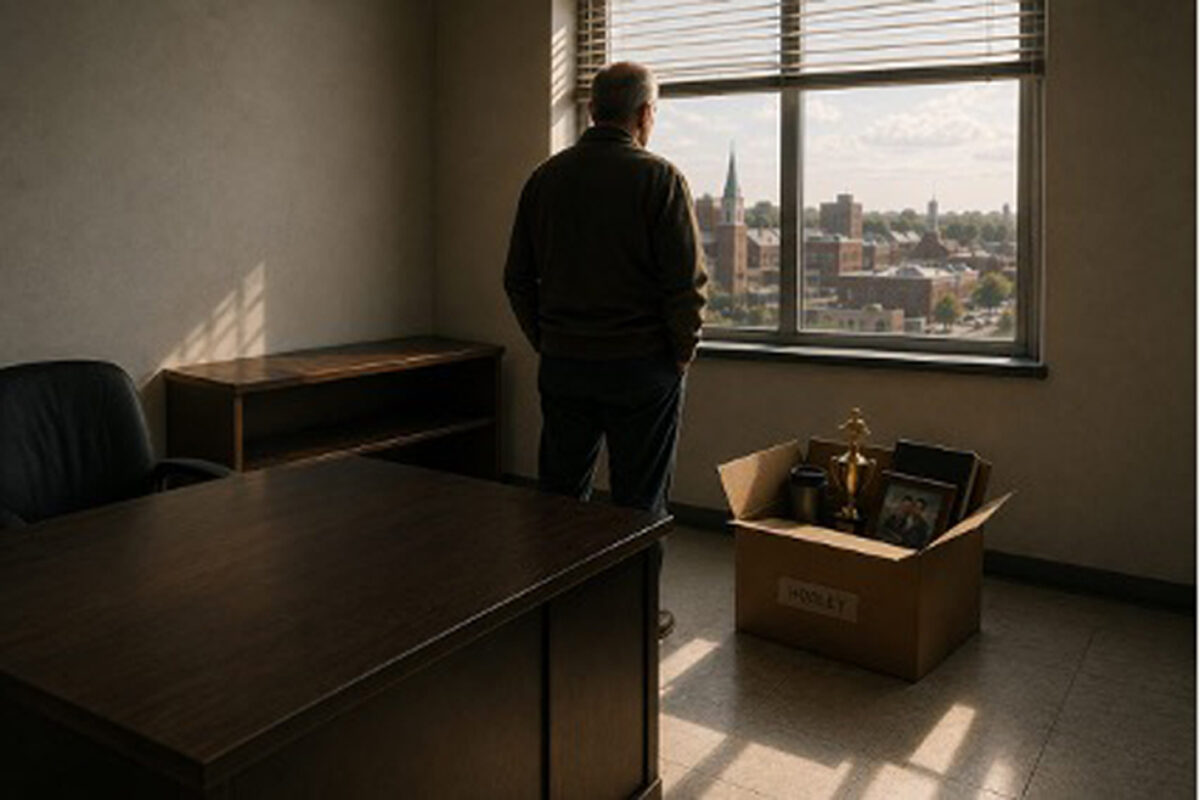
At 9:40 a.m. on his final morning working for the Florence County Police Department, Hooley sat at his desk with a blue coffee mug in his left hand and a half-eaten raspberry-filled doughnut between the fingers of his right hand.
Beneath the only window in his office was a lonely cardboard box of personal items. The top of the box remained open for last-minute additions. He could see a small gold-painted plastic trophy from 10 years ago that read “World’s Punniest Detective.”
His partner, Richard Marchais, leaned against the door frame, fingering his recently repaired incisor.
“Any pain?” asked Hooley.
“Only my checking account. I could have bought a racehorse. Make a note: our dental plan works a lot better if you don’t use it.”
“Noted.”
“So, what are we going to do on your historic last day? Fly to Disneyland and ride the Pirates of the Caribbean?”
Hooley shrugged. “Dunno, it’s my first-ever last day.”
Marchais said, “Hey, while I was getting drilled by the dental thief, I missed yesterday’s developments on the racehorse with the crazy divorcee scam artist. Bring me up to speed.”
“The lady in the red wig is letting the short-term ex keep the horse and any money the horse makes. She wants out. The injury was accidental.”
Marchais asked, “What did you think of the sport, you know, the racing part?”
Hooley said, “I liked it. Good people. Amazing horses. Our potential perp isn’t really a horseperson, so I’m not counting him. My guess is the horse racing world is full of regular people with a few bad apples.”
“Just like us.”
“Yep.”
Hooley emptied the coffee cup and dropped the napkin into the basket near his feet. His partner looked out the window. Neither said anything for a minute.
Then Hooley clapped his hands and said, “Let’s go back to the racetrack and nose around a little bit more on the racing thing.”
Marchais nodded. “Sounds like a good way to fill the historic day, better than watching the clock and reminiscing, plus we haven’t had a chat with the trainer when his cousin wasn’t around. Let’s saddle up.”
“Harness up.”
“Yeah, whatever.”
One hour later, the guard waved the Range Rover through the open gate of the racetrack. The first person they saw was Spit Kendrick pushing a wheelbarrow with a bundle of straw. Spit stopped, set down the handles, and walked to the passenger window.
Hooley pushed the button. The window slid open.
Spit squatted and hung from the window in a yoga pose. His smile displayed the gold tooth in his wrinkled black face.
He said, “Well, well, if it ain’t Sherlock and Watson returning to the scene of the crime. Now who’s Sherlock? I always go straight to the boss man.”
Hooley said, “Wrong movie, we’re Dumb and Dumber.”
Spit’s smile grew. “Well, Mister Dumb, I’m sure we all watched that replay and the kerfuffle with the finger after the race. Ain’t never seen nothin like that. That video could stir up some serious internet traffic.”
Hooley smiled. “Hey, Spit, thanks for the tip about the replay. You cracked the case.”
“Do I get a reward, you know, like a bounty?”
Hooley saluted. “Just the heartfelt thanks of a grateful nation.”
Spit smiled. “Thanks is hard to spend. So, what brings you back? You making one of those TV shows? Is Pioneer Park a new hotbed of crime?”
“Just wrapping up, but if I get any wind of a reality show set on the backstretch, you will be on the list, maybe have a starring role.”
“Make sure old Spit is on the list that pays real money.”
“Deal,” said Hooley.
Spit stepped back from the Rover, gave an exaggerated salute, and marched to his wheelbarrow. As Hooley guided the Range Rover toward the barn, his phone buzzed. He read the display, tapped the button, and put the phone near his ear.
“Hello, Martha. Let me put you on speakerphone. Detective Marchais will be your contact in the future. Today is my last day. I turn in my badge and equipment at 5.”
He pushed the speaker button.
Marchais joined and said, “Good morning, Martha. What can we do for you?”
She said, “I didn’t know if I should bother the police, but there are a few things I found this morning when I was cleaning out the garage. I’m downsizing and started with my husband’s workbench – my first husband, Charles, my real husband.”
Hooley said, “Got it. Alex doesn’t strike me as a woodworker, more of a termite.”
She laughed. “Ever since COVID, Charles followed conspiratorial media. The advertising on his shows compelled him to purchase generators, first aid kits, and cartons of survival food. His politics were a friction point for us.”
“Sure, plenty of that sort of friction going around.”
“When Charles became ill, one afternoon, after one of his treatments, he took me into the garage. On his workbench was a toolbox closed with a small padlock. Charles reached into a mason jar with nails and bolts and fished out the key and opened the tool chest.”
“And?”
“The chest had a top section with a handle you could grab and lift out. A tray. When Charles opened the toolbox and removed the tray of tools, on the bottom of the chest were two closed cigar boxes.”
Hooley and Marchais waited.
“Charles showed me that inside the first cigar box was a mishmash of gold coins, French gold francs, and a small gold ingot about the size of a candy bar. And some medallions. Products that were advertised on his shows to guard against the economy crumbling and rampaging immigrants.”
Marchais chimed in, “There are probably plenty of people who stash that sort of stuff.”
“Well, if there are, and if they are like my husband, they are in for some financial disappointment at the end of civilization.”
Hooley asked, “Not as valuable as he thought?”
“No. One afternoon, with Google and AI, I researched the value of the contents of the secret cigar box. His entire stash is mostly advertising nonsense. Behind the hype, the value in the real world was maybe $5,000.”
Hooley asked, “The other cigar box?”
She paused.
“A pistol.”
“What kind?”
“Small, it looked like a toy.”
Hooley said, “Let me guess, when you looked this morning, the cigar boxes were empty?”
“Of course.”
“Alex?”
“Of course.”
Hooley and Marchais exchanged a look. Missing gold was one thing. A missing gun was another.
Marchais asked, “You want to file a report for an insurance claim? Add theft and possession of a firearm to his resume?”
“No, no, absolutely not. My plan is selective amnesia. I just thought you should have this information.”
After a few pleasantries, she agreed to send a list of the missing items and registration papers for the gun. They ended the conversation.
Before they got out of the car, Marchais asked, “You going to miss this crazy stuff, cops and robbers?”
“Mixed feelings.”
“You got any plans? You know, things to keep you busy?”
“Got a few, but I’m nervous. This has been my life; two-week vacations made me jangly. “
“I understand. It’s new territory for an old dog, but you will do fine. Just stay away from buying an easel and oil-painting pictures of cherubic nymphs or hiking the Appalachian Trail in flip-flops.”
“Off the bucket list.”
“And cross off taxidermy and mud larking.”
“Mud larking?”
“Yeah, I read an article about it last week. Possibly sane people who travel around and wade in old riverbeds, sloshing around in gooey mud for lost treasure and historic items.”
“Actually, that doesn’t sound bad.”
They both chuckled, then sat quietly for a few moments. Five o’clock was getting closer.
Stay on top of all harness racing news.
Join the HRU mailing list, free.