




Mike Gulotta is optimistic about harness racing’s future in the Garden State

by Murray Brown
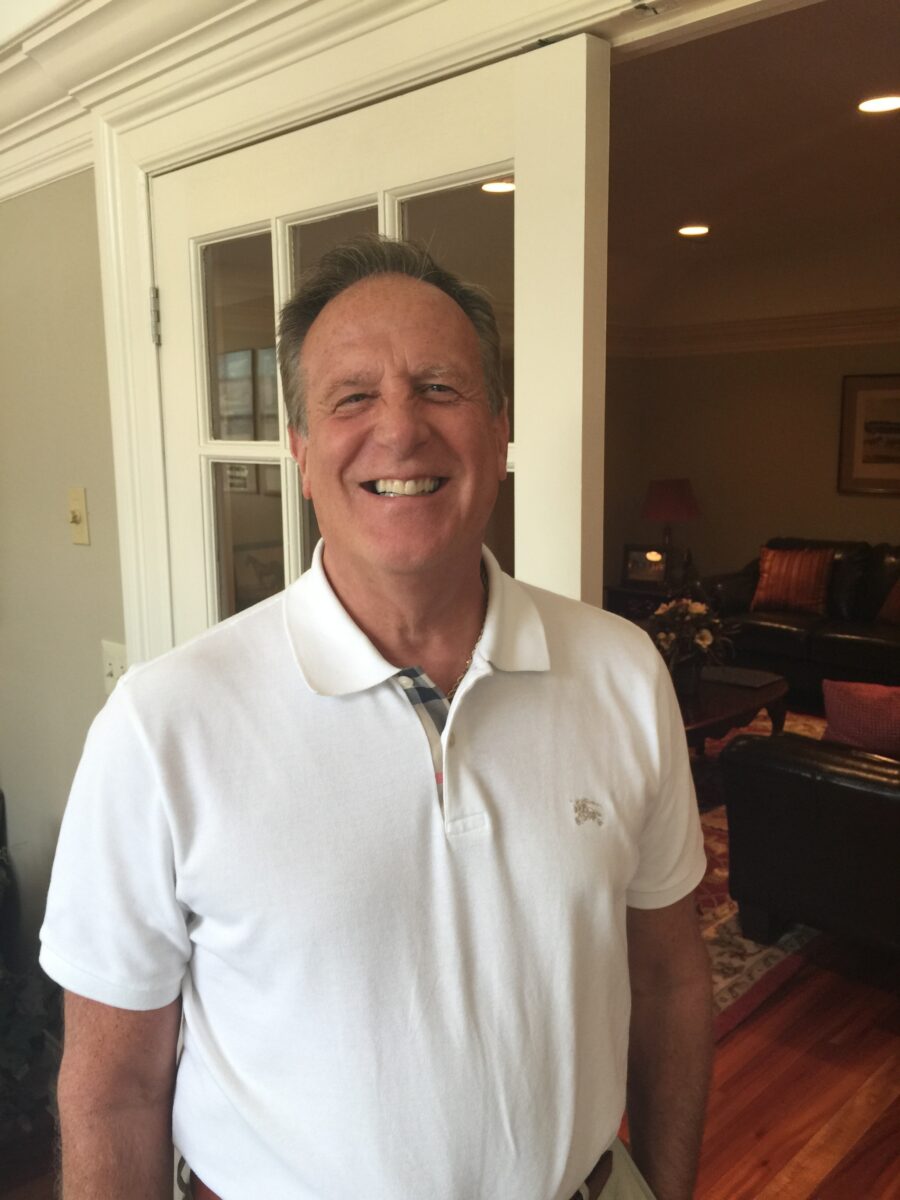
Mike Gulotta is a Brooklyn boy who grew up in a middle-income family. Through hard work and a rigorous education, he earned the highest level of actuarial designation earning a doctorate degree in the process.
He was even once featured on the front page of the Wall Street Journal.
Thanks to his grandfather who first introduced him to harness racing at Yonkers Raceway when he was 12 years old, Gulotta later ventured into the industry, first as an owner and many years later as the founder and CEO of Deo Volente Farms, soon to become New Jersey’s last full-service standardbred breeding farm.
Let’s start at the beginning. What is an actuary?
“In quite simplistic terms, an actuary is a person in the insurance industry, who, through the use of statistics, determines the probability of events taking place. In reality, it is far more complex than that.”
It’s somewhat of a twisted road from you being an actuary to becoming the head of arguably the leading breeding farm not only in the state of New Jersey, but being one of the best known in North America and throughout the world. What led you to this status?
“A simple two-word answer to that question would be ‘Worldly Beauty.’ But the reality is more involved than that. I had discovered the joys involved with owning standardbred racehorses. I had owned a good number of them to varying success. Some were good. Others were not nearly as successful.
“Then Worldly Beauty came along.
“Most of my horse holdings to that point involved buying and owning racehorses. We’d buy proven campaigners and would try to sustain or improve upon their success.
“I hadn’t tried the yearling game much. At Harrisburg in the fall of 2000, Joe Parisi’s White Birch Farm was selling this very well-bred Artsplace filly named Worldly Beauty.
“She was royally bred, extremely well conformed, and beautiful, but small. Ordinarily she would have been expected to bring a huge price, perhaps $200,000 or even more. But her diminutive size hurt her price. We were able to buy her for $87,000. She became one of the best fillies ever as a 2- and 3-year-old, going on to earn $1,900,255.
“When her racing career was over, we wanted to acquire babies from her. In simplistic terms, that led to the establishment of Deo Volente Farms. It’s not quite that simple, however I would say that without Worldly Beauty, Deo Volente Farms probably would not exist. Worldly Beauty is still with us as a retiree on the farm at the age of 27.
“She is the gift that continues to give. She has produced a total of 15 foals. Three of her daughters are members of our present broodmare band. She earned near $2 million and we have sold eight of her yearlings for a total of $945,000. Not too bad for an $87,000 investment.”

You’ve returned to the genesis of your experience in the business as an owner of a high-quality racehorse Bourbonista S, a mare who may very well be the best trotter in North America. How did that come about?
“Actually, we’ve never stopped owning parts of racehorses. The great ones such as ‘Bourbonista’ sometimes may be few and far between. I was friends with her breeder and owner Jens Hanson [Panamera Racing]. He had brought her along slowly, racing in Scandinavia. She had reached the level where she was one of the best trotters there. I was speaking with Jens and he mentioned that she would be coming to race in the States. He asked if I would be interested in becoming his partner. Indeed, I was. We bought in. She has been great. She set the world record of 1.48.4 at The Meadowlands. She has won four of her six starts while in the Melander Stable. She has been invited to start in the $1 million Yonkers International Trot. That should be fantastic. She is the kind of trotter owners dream of sometimes having.”
Each year the Deo Volente farms yearlings represented by Preferred Equine Marketing are featured in the Lexington Selected Yearling Sale. What should the discerning buyer look for in this year’s group?
“We have 14 yearlings in total, 10 of which are solely farm owned and four which are owned in partnership. I think that as a group they are exceptional. But I guess that most breeders will tell you that. We probably shouldn’t be breeding horses if we didn’t think highly of them.
“You’ve limited me to one pick at each gait, so here goes:
• My pick of the pacers is Hip #187 Rebel Deo. He’s a Confederate colt, out of the 100 per cent producer Miss L A. He’s a half-brother to the million-dollar plus winning filly Rodeo Drive Deo.
• With the trotters I really like Hip #327 Lionheart Deo. He’s a Chapter Seven colt out of Princess Deo [$459,308] who is in turn a daughter of the world champion Queen Serene [$748,602].”

The decision of Southwind Farms to cease operations will leave Deo Volente as the last full service commercial breeding farm in the state of New Jersey. That and the decision regarding the Hambletonian moving to Indiana leaves New Jersey recently receiving a double-edged whammy. What do you see as the future for breeding and racing in New Jersey?
“I’ve always been what I regard as an eternal optimist. I’m a big believer that many times after a storm a beautiful rainbow appears. There are several factors upon which the future success of harness racing in New Jersey is based.
“The first and most important in my view is cooperation between the three most important entities regarding harness racing in the state — the legislature in Trenton, The Meadowlands Racetrack and its leader Jeff Gural, and the Standardbred Breeders & Owners Association of New Jersey [SBOANJ].
“Another factor of perhaps equal importance is the retention of the stallions presently at Southwind Farms. There is no farm anywhere in the world that stands a group of stallions comparable to Karl, Legendary Hanover, Tactical Landing, and Walner. It is of prime importance that all of these stallions remain and thrive in our state. I’d be disingenuous if I didn’t mention that I thought that Deo Volente Farms would be a great place for them to stand.
“As for the Hambletonian, I regret seeing it move. But The Meadowlands is still the greatest harness track in North America, if not the world. The Jersey program is still an excellent one. With the continued help of the state and the support of The Meadowlands and the SBOANJ it can thrive and grow.”
Stay on top of all harness racing news.
Join the HRU mailing list, free.