



David Reid reflects on a banner week for Preferred Equine
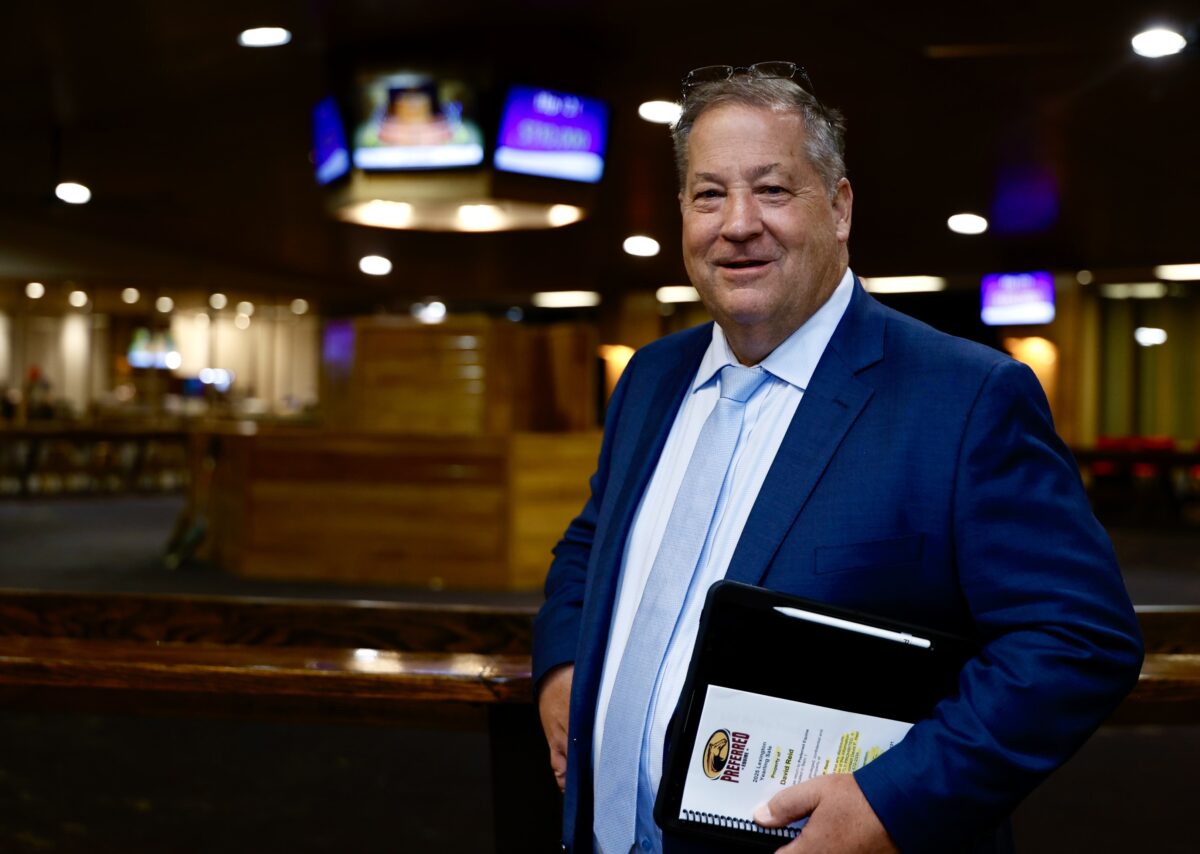
On the cusp of enshrinement in the Harness Racing Hall of Fame, David Reid set an all-time consignor record at Harrisburg when his Preferred Equine had sales exceeding $31 million.
by Debbie Little
At this year’s Standardbred Horse Sales Company’s auction in Harrisburg, PA, Preferred Equine set an all-time consignor record of over $31 million, $25 million of which came from the Mixed Sale. Preferred was responsible for over 41 per cent of the sale’s total gross of just shy of $75 million.
“That was good work,” said David Reid, president of Preferred Equine. “It was a lot of work. It doesn’t come easy, but it was definitely a good week overall, cumulatively, for sure.”
Preferred, which once had its office around the corner from The Meadowlands and has long sponsored the starting gate at The Big M, was established in 1989 by Reid and the late Geoff Stein. According to Reid, their plan for the future back then was simple.
“Make a living,” Reid said with a laugh. “Like everyone else’s goal, you want to make a living. That’s what our goal was. We liked the horses. We liked the horse business. Geoff always had a passion for horse racing, and I was always in agriculture, so it was a time when you think about stuff you might do, and you want to do the best you can, as much as you can, and be as successful as you can, not only for yourself, but for your clients… provide a service to the industry to some degree. You get paid a fee for doing such, and you hope you make enough at the end of the year to make a living. That was the goal when Geoff and myself were together, for sure.”
Although many consignors go into a sale with a number in mind, which, if met, would make them happy, according to Reid, that is not his modus operandi.
“So, contrary to every other consigner, I don’t look at things that way,” Reid said. “I’ve never looked at them that way. The $31 million, you’ve got to break it out into five days.
“The yearling portion of it, it’s one set of clients, and they have a certain expectation. And I would say that the yearling sale portion of it was consistent, probably, to the marketplace as it has been all year, relative to the [other] yearling sales. The lower and medium-price yearlings I found to be a little bit more difficult in that area, and I felt that the top of the market was industry standard. I wouldn’t say it was better, I wouldn’t say it was worse, it was industry standard, from what I’ve seen through the year so far. So, that’s how I’d summarize the first three days.
“Obviously, some clients were happy, some were maybe less than happy, but at the end of the day, Preferred Equine clients know that the marketplace is what it is, and we do the best we can. And as far as anybody having any individual numbers preset, maybe my sellers that consign with me had something in their mind and they wouldn’t share that with me, that would be a personal situation. So, from a Preferred Equine point of view, we don’t have any set numbers per se, going into a yearling sale.”
According to Reid, Day 4, the start of the Mixed Sale, presented some rare opportunities because of the dispersals.
“The dispersals are all unique,” Reid said. “We started off with the Fair Winds Farm one, and then we had Fashion Farms, and then we had Libfeld and Katz, and then we had Stonebridge [Farm], which was a small one, and then we had spattered throughout the day, our general consignors.

“Anytime you get a dispersal, it’s always interesting to find out how the public would react. And in the case of Fair Winds, that was just kind of like a normal, regular dispersal, where Fashion Farms, a lot of their pedigrees have been developed by Jules [Siegel] and Fashion Farms, and have not been available to the public. So, from a racing point of view or breeding point of view, some were respected more than others in the auction ring, and some sold very well, and some sold maybe what expectations were. But it’s good to see that the public can adapt to the marketplace and what’s going to be available, which is a rare offering. And then you slip into the Katz/Libfeld situation, and there again, it’s a unique situation where two long-time partners have decided to go their own way, and there were unique offerings in there as well, and as such, they brought the prices that they did.
“Stonebridge was smaller, but all the dispersals, I felt, had a great amount of outside interest, which you would always expect and hope would happen in the marketplace, but you can’t predict that. At the end of the dispersals, to see the amount of active bidders on those horses was very satisfying, and as such, it reflected that the prices were very well received from the sellers.”
Reid then touched on Day 5, highlighted by the “Fabulous Fillies” section.
“You start off with the 2-year-old racehorses, but the first power of the day, or the first very attractive lots to be offered are the Fabulous Fillies, and obviously the two there, Date Night Hanover and Kadena, they were both high-priced yearlings when they sold, they both have pedigree performance and looks… and as such, when horses like that are offered, people are trying to improve or add to their broodmare band, and in the case of Date Night and Kadena, I think they were both purchased by Armitage Farm.”
Kadena topped the sale on the final day, bringing $1.2 million, while Date Night Hanover was second, when hammered down at $985,000.
“Going into the sale you’re always expecting them to sell well,” Reid said. “What’s well? It’s all relative. It didn’t surprise me of the price either one of them sold for. If they’d sold for a little less, would I be surprised? No. If they’d sold for a little more, I wouldn’t have been surprised. There’s a general ballpark, which you’re thinking of, and they fell into the ballpark which I was thinking. And then the number of male racehorses that were offered was down over years past. And Fallout sold for $500,000, and there again, it’s a unique opportunity to get a high-level horse. There were several bidders on that horse and Burke Stable ended up getting the horse, but you’re paying for a proven performer. There again, no expectations going in, per se, but you know he’s not going to sell for $100,000, it’s just a matter what the marketplace dictates what he’ll sell for.”
Preferred Equine is busy 12 months a year representing not only breeders, but racehorse people, and stallion shares. They’re syndicate manager for Walner, Legendary Hanover, Winners Bet, and Cuatro De Julio, conduct online sales every two weeks, and do stallion management, as well as breeding consulting. Reid is also the co-manager of the Lexington Selected Yearling Sale. Preferred is also a growing force in the thoroughbred business.
And although Preferred dwarfed the previous Harrisburg record of $20.5 million, which they set last year, Reid was quick to point out that he is not a one-man show and that Preferred’s seven or eight full-time office employees as well as the 75 to 100 – depending on the day – workers at the sale, all contributed to the achievement.

“Obviously, [$31 million] is a sizable jump, and when you do $20 million in sales, you don’t think you’re ever going to repeat that again. But only a unique situation like we had this year would present that opportunity,” Reid said. “So, we’re happy to take the opportunity, but on the other hand, would we prefer no dispersals, and the clients stay in the business? Personally speaking, I would prefer that, but you can’t control that. And Preferred Equine has, I think, a strong reputation of representing the best in the business, and we’re happy to represent the high-end clients that are looking for outstanding service, which we try to provide.”
Although many had a good sale, Reid said he thought the low end of the market was probably the worst part of the sale, and regardless of where the sale takes place, be it small, regional ones throughout the country or the big ones in Lexington or Harrisburg, it will be reflective of the overall health of the industry.
“I personally feel that the industry as a whole could do a lot of things a lot better,” Reid said. “Whether that’s racetrack management, racetrack promotion, the overall experience for owners, post-time drag, transparency with CAWs, that kind of thing is the state of the industry and would reflect on the results of the sale. It’s not the sale creating the state of the industry, if you follow me… And so, this is not a 2025 issue, it’s a 2015 to 2025 issue, the last 10 years. These things don’t happen overnight, and you know, when you have a disruption like they did 15 years ago or 13 years ago, however many up in Ontario, when the [Slots at Racetracks Program was cancelled], it affected the industry, and there are a number of tracks that closed. You hear Jeff Gural comment that he doesn’t have a casino at The Meadowlands. So that’s a factor… People want to talk about the sales, but they don’t want to talk about the overall industry, and I think sometimes it’s a little unfair during sales season that the sales companies go under a microscope when the rest of the industry perhaps doesn’t go under the same microscope.”
Reid will be inducted into the Hall of Fame in Goshen, NY in July of 2026 and join his late partner, Stein, who was inducted as an Immortal in 2021. Apart from operating Preferred together, they both were co-owners of the great trotting mare Moni Maker.
“Well, obviously, it’s a huge tribute, and it’s a very humbling experience, but for myself personally, it’s never one of those things you set as a goal,” Reid said. “And I’m sure there are other people in the industry that maybe deserve to be in there before me, but you can’t change that. So, I’m thrilled to go. But more importantly, I’m thrilled to join Geoff, and it’s definitely a very personal, emotional, sentimental feeling. There’s no doubt about that. So, it’s extremely gratifying and extremely humbling and extremely emotional… He’s been gone 13 years, and to keep the projection of Preferred Equine going at the highest level possible, or even higher, is even more gratifying, or satisfying, knowing that he would be proud of the success that’s happened going forward, because, you know, not that Geoff was a farmer, because you know me and him were different, but it’s equivalent to planting seeds and seeing the fruit. Our time together was extremely special, and we learned so much from each other that you would like to think that the success was planted a long time ago, and it just continues to bear fruit. I just thought of that off the top of my head right now, and that’s probably going to be brought up again in an analogy at the Hall of Fame. But no one achieves fame or honors without support. It takes a lot of effort from a lot of people to succeed.

“Looking at the amount of Hall of Famers that we represented, that’s even more gratifying. You take the trainers and the drivers that we’ve had close relationships with over the years, and then you look at the breeders, the Antonaccis, going from Frank from Crown Stable to Sonny Antonacci to Frank Antonacci to the Skolnicks, Charlie Keller – I’m going to forget somebody – we represented all these people, and that, in itself, is a great honor. Arlene and Jules Siegel, Hall of Famers, Jimmy Campbell, Hall of Famer; Jimmy trained those [Siegel] horses. Moni Maker and [Jimmy] Takter and Wally Hennessey; I’ve known Wally forever. So, not only to Geoff, but it’s to all the other friends and/or clients that we’ve had long associations with, to join them; it’s a fraternity, to some degree, and it’s a great honor and so very humbling.”
Stay on top of all harness racing news.
Join the HRU mailing list, free.