




How trotting sires did at Lexington
by Murray Brown
Before my chronic back condition prevented me from making an annual trip to Lexington in the fall, there was no place on earth that I looked so forward to coming to and spending a week or more.
On the other hand, if bad weather was on tap in Lexington, after the first week, or sometimes less, there was no place I looked more forward to getting out of and back to the less enjoyable comforts of my home and sleeping in my own bed.
Why the dichotomy you might ask? I believe it relates to the major question I asked when writing of the trotting yearlings by sire at the Lexington Selected Yearling Sale a few weeks back. Can there be too much of a good thing? The answer in my less than astute opinion is a qualified yes.
What is there about mornings in the beautiful Bluegrass, afternoons at The Red Mile watching the best trotters and pacers in the world being driven by the very best drivers, emanating from the finest Grand Circuit stables known, then usually followed by sessions at the number one standardbred yearling sale known to man (and woman) offering the best pedigreed, conformed and presented yearlings in our sport?
There is also the numerous outstanding restaurants and bars available in Lexington, together with the many horsepeople with whom you are able to share those pleasures. What can be even possibly construed as being negative about that picture?
I’ve come to the conclusion that was the similar situation that Dave Reid and Bruce Brinkerhoff found themselves in when aligning this year’s sale catalog. Did they have too much of a good thing, especially when it came to trotting yearlings? Days 1 and 2 for the most part, were excellent and mostly as expected. In Day 3 there was a dip, but a small one. By Day 4 (Thursday) many of the attendees were worn out and a good many got out of Dodge. I wasn’t there but I have it from good sources that the crowd was noticeably sparser than that of the previous three days. In simple terms, there were a lot of people, especially of a certain age, who were exhausted and wanting to get home. By Day 5 (Friday), there was a significant realignment of yearlings and the people there to buy them and the sale was back on course.
When writing of the trotting sires, I mentioned the law of supply and demand several times. With some sires to varying degrees, they were able to handle the large numbers of yearlings sired by them. To a great dominant sire like Walner having 80 yearlings in the sale might have been easier to overcome than perhaps a perceived middle of the road sire like Father Patrick with 20. However, with almost all of them, if there was the exceptional one or more yearlings, those were almost always found by the buyers.
Here are most of the trotting sires mentioned in my original post together with my assessment of how they did in the sale:
Alrajah One IT — In his first crop, this hybrid son of Maharajah had eight yearlings on offer. There was one exceptional one, Hip #50 Valorous that I mentioned Steve Jones having said was the finest yearling he had ever raised. He certainly did not disappoint. He sold for $575,000 to my friend Dave McDuffee. It is my practice to generally pre price all the yearlings in the book. I had Valorous priced at $300,000. However, when prices get that high up, there is no telling what the final price will be. The other seven Alrajah’s for the most part did not disappoint, bringing prices from a low of $8,000 to a high of $35,000, with most of them being in the $30,000 price range.
Calgary Games — This hybrid son of Readly Express had five yearlings on offer. His first crop in America have raced reasonably well. He was going against limited sire stakes eligibility because they were conceived with frozen semen imported from Europe. They brought a low of $20,000 to a high of $50,000.
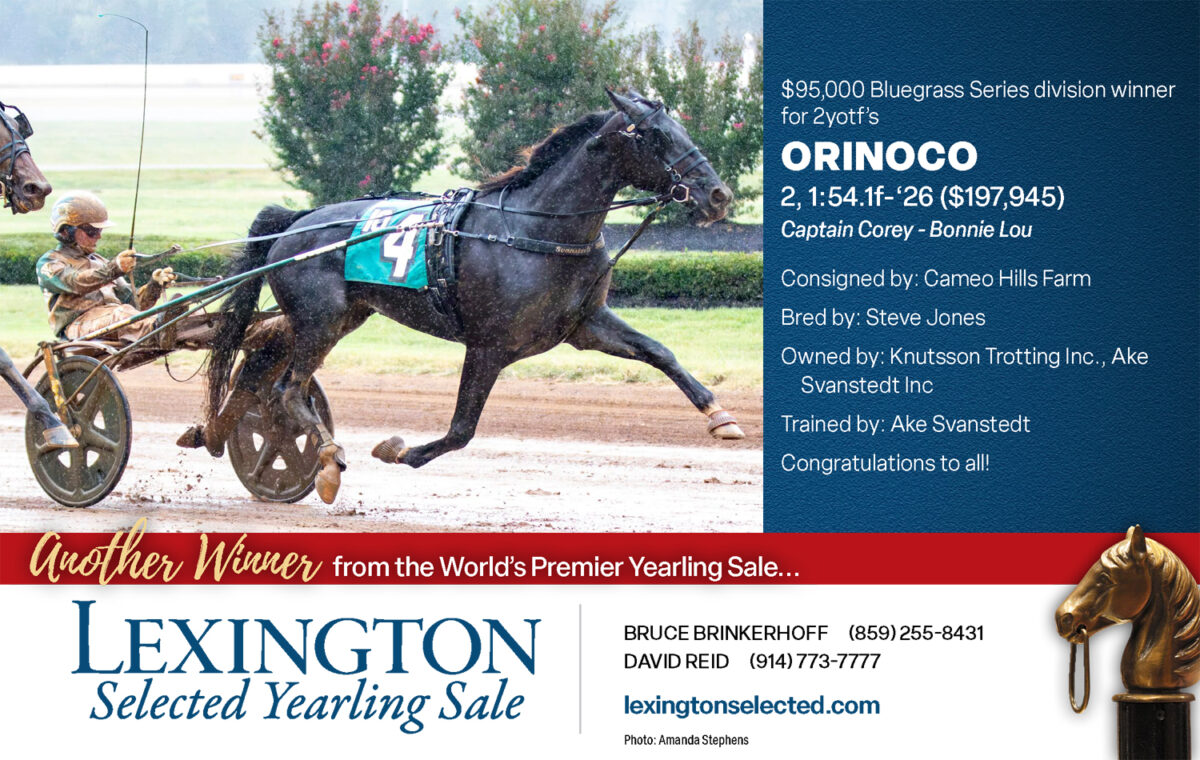
Captain Corey — Arguably the hottest trotting sire in America, from his first crop of 2-year-olds, he is the leading money winning sire in North America. I heard some mentions of if he was that good, then how come he had only one yearling selling on Day 1? My response was that if the buyers liked them enough, they would find them regardless of which days they were scheduled to sell and they did! The 43 yearlings by this hybrid mostly sold very well from a low of $18,000 to $750,000 for Hip #182 Jimdougie Armitage, the highest priced trotting colt in the sale. Among his yearlings were 12 that brought $100,000 or more.
Chapter Seven — With ٦٤ yearlings in the sale, I had a little concern that he might be hurt by such a large number, but only a little. He passed the test with flying colors. His yearlings ranged in price from $10,000 to $425,000, with a staggering 33 of them bring $100,000 or more; eight of them brought at least $200,000.
Cuatro De Julio — Five yearlings from the first crop by this hybrid son of Trixton, all of them being sold by the world›s greatest all around horseman Jean Pierre Dubois. I would say that they sold reasonably well bringing from $٢٢,٠٠٠ to two at $٥٠,٠٠٠.
Ecurie D DK — There were ٢٤ yearlings on offer from the first crop by yet another hybrid. I felt they generally sold reasonably well, from a low of $٨,٠٠٠ to a high of $٢٧٥,٠٠٠, with three of them reaching the six-figure mark. I’ve been told that they usually looked the part. Let’s hope they do the same when racing.
Father Patrick — A good, well proven sire who may have been hurt by a few factors: perhaps too many of them for the market to absorb, the competition being very difficult, and being in Pennsylvania which in recent years may have taken a back seat to Kentucky, Ohio and Indiana. The yearlings ranged in price from $15,000 to the $320,000 fetched for the half-sister to Karl.
Gimpanzee — Heading into the sale, I felt that Gimpanzee was hurt by two factors: the first was the inordinately large number, 52 of them, and the second being that he is viewed by some as being only a regional sire, in this case one to which Kentucky stallions are eligible. The fact that although his numbers are good, he has yet to come up with the one great horse. Nevertheless, the cream rose to the top. He sold a $800,000 filly on opening night, with another fetching $225,000. The others ranged in price from $8,000 to $85,000.
Green Manalishi S — The leader in Ontario was represented by seven yearlings. They sold from $٥,٠٠٠ to $١٤٥,٠٠٠, with two of them exceeding the $١٠٠,٠٠٠ mark.
Greenshoe — A horse that I would label as being a very good, perhaps approaching being a great sire. But he is still recovering from what I perceive as a poor first year followed by two solid ones. He was represented by ٣١ yearlings, a number that I thought could hurt him and perhaps did somewhat. Nevertheless, I felt that he did okay, but just okay. His yearlings sold from $8,000 to $210,000, with five bringing a credible $100,000 or more.
International Moni — Two factors were going against this reasonably successful son of French import Love You: first, the number of 27, far too much for this marketplace to absorb, the second was the perceived hurting Pennsylvania market where he faces tough competition from rising super sire Captain Corey. His 27 yearlings sold from a low of $2,000 to a high of $75,000.
King Of The North — The son of great sire Walner was making his debut with ١٧ Ontario eligible yearlings. My assessment was that he did very well, indeed. They appear to be very well received bringing between $٢٠,٠٠٠ and $٤٢٥,٠٠ with six of them attaining $١٠٠,٠٠٠ or more.
Muscle Hill — The king is still alive and doing quite well thank you. He was represented by ٣٨ yearlings, a large number for a horse that might be perceived as being in his twilight years. They sold at prices between $١٨,٠٠٠ and $٤٧٥,٠٠٠ with ١٦ reaching the $١٠٠,٠٠٠ plateau and five at $٢٠٠,٠٠٠ or more.
Rebuff — This son of Muscle Hill made his debut with seven yearlings, all selling in the traditional Friday night Indiana session. They ranged in price from $١٢,٠٠٠ to $٧٥,٠٠٠. We should be seeing a lot more of these in the upcoming Indiana sale.
Six Pack — This New Jersey stallion who stands in the most competitive region in North America where his competition is Muscle Hill, Tactical Landing, and Walner. Despite that formidable competition he is the sire of this year’s Hambletonian winner Nordic Catcher S and the Grade 1 winning 2-year-old filly Sugar Packet. Despite those accomplishments, his sale can only be described as disappointing. In price, his five ranged from $4,000 to $25,000.
Swan For All — The perennial leading Indiana sire was represented by three yearlings ranging in price from $١٧,٠٠٠ to $٣٠,٠٠٠.
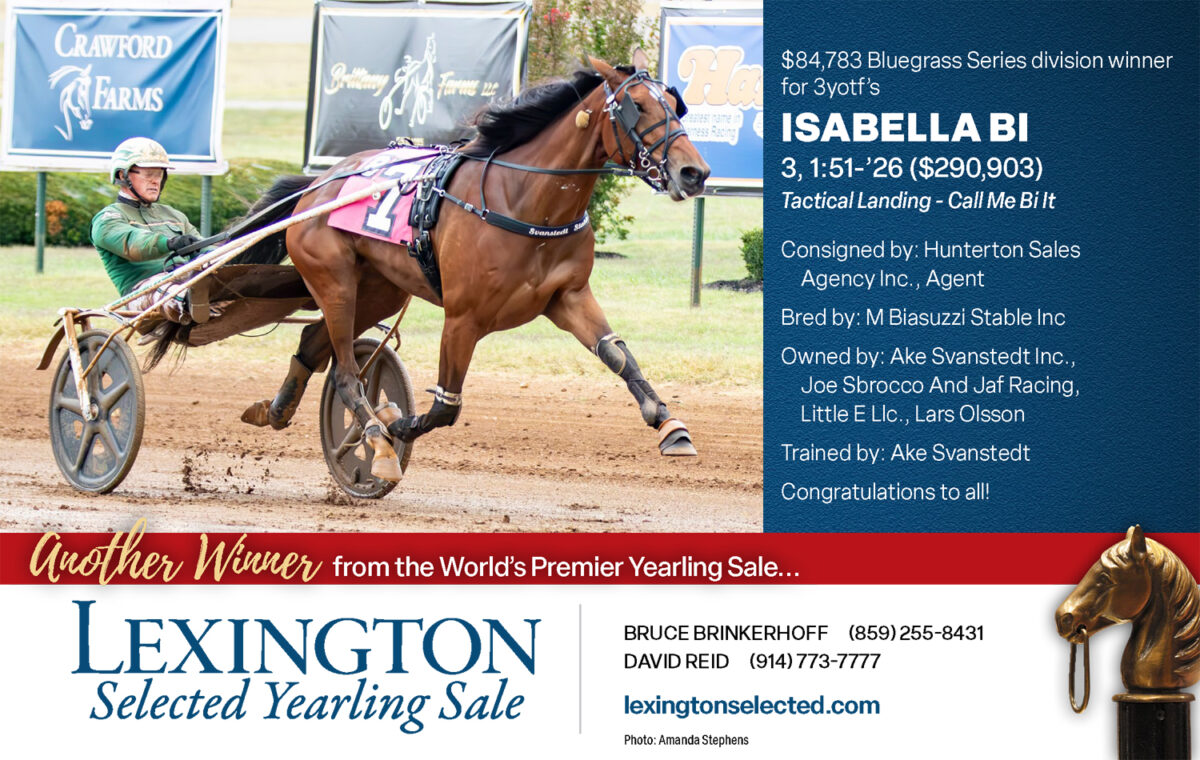
Tactical Landing — Undoubtedly one of the breed›s greatest trotting sires, he had 42 yearlings entered in the sale. If ever there was a stallion of who you could say, they either love them or they don’t, Tactical Landing is such a horse. They ranged in price from $8,000 to $290,000 with, in my opinion, far too many in the lower ranges for a stallion with as much success as this horse has had. There were still eight that brought $100,000 or more with four of those in the $200,000 bracket.
Temporal Hanover — This eagerly awaited son of Walner made his debut with seven yearlings, all selling on Friday typically Indiana night to which sire stakes program these yearlings are eligible. They ranged in price from $25,000 to $80,000.
Walner — This was the horse who, to me, presented the greatest question. Can any stallion handle 80 yearlings at a single sale? At what point does the law of supply and demand come into force? There is no doubt that Walner is one of the world’s greatest trotting stallions, but how much is too much? I think Walner did exceptionally well. The $100,000 threshold was reached by 34 of them; 12 exceeded $200,000 and three reached the $500,000 plateau with Hip #70, the filly Dejeuner topping the sale at a cool million dollars.
Stay on top of all harness racing news.
Join the HRU mailing list, free.