




Picking the best horse in the sport’s greatest rivalries
From Adios vs. Kings Counsel all the way to Twin B Joe Fresh vs. Sylvia, here are my picks for the best of those epic battles.
by Murray Brown
I received an email from Howard Pearce the other day. Pearce is a long-time owner and syndicate manager of horses in Mark Steacy’s stable. Pearce suggested that I do a column on rivalries among horses that I’ve witnessed or perhaps been aware of, speaking most specifically of that between the two great mares Sylvia Hanover and Twin B Joe Fresh.
Here are some of the ones that come to mind in reverse chronological order.
I am certain there are some I’ve left out. There are undoubtedly a few among these that are not rivalries in the truest sense, but are only included because of situations that motivated my including them.
FOALS OF 2020 – SYLVIA HANOVER VS TWIN B JOE FRESH
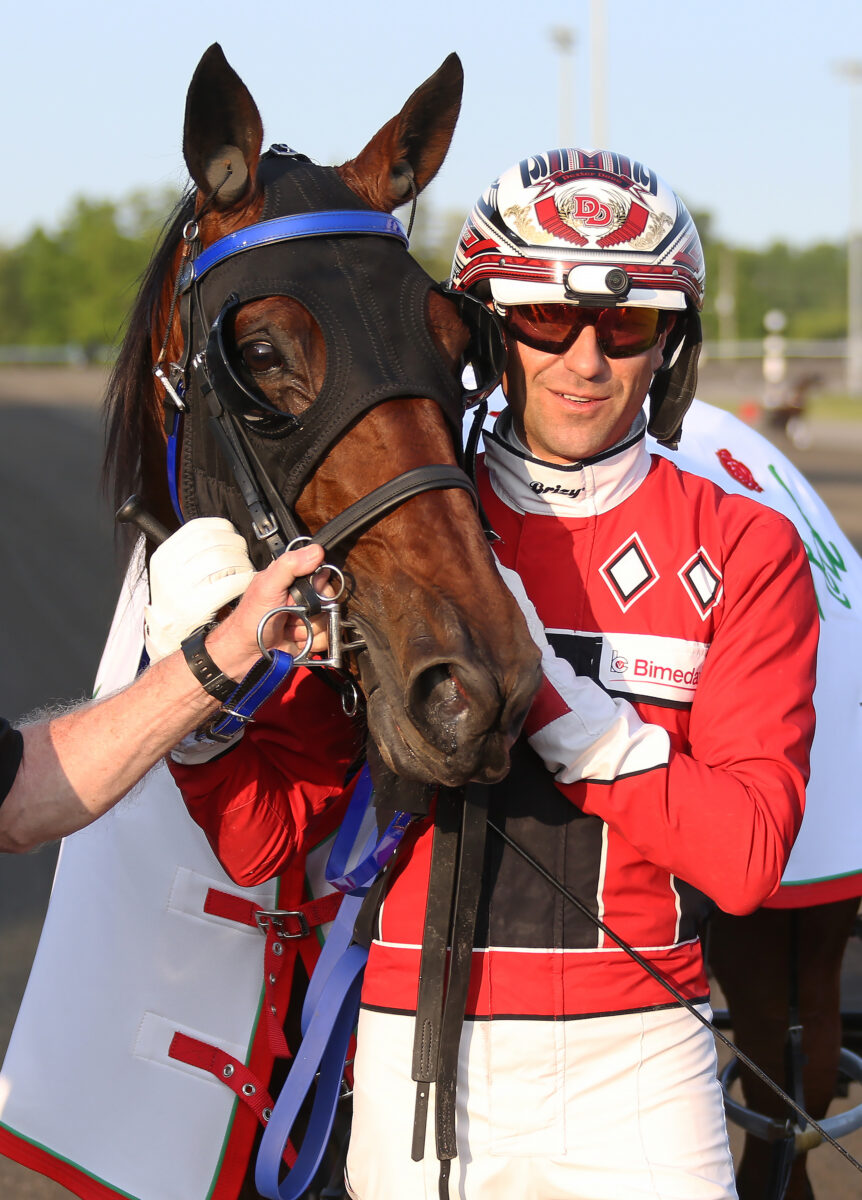

As of this week, these two are still going at it hot and heavy. The latest in their ongoing battles being won at The Meadowlands in last Saturday’s (Aug. 2) Lady Liberty by Sylvia Hanover in 1.48.2. To date, each of these mares has 46 lifetime starts. Sylvia Hanover has been on the board in 40 of those races, winning 27, with earnings of $2,079,354. Twin B Joe Fresh has been first, second or third in 44 of her starts, winning 33 of them and earning $2,634,879.
Verdict: Dominance thus far, would have to go to Twin B Joe Fresh, but the battles are far from over.
FOALS OF 2017 – PAPI ROB HANOVER VS TALL DARK STRANGER
On the racetrack, Tall Dark Stranger holds a very distinct advantage having earned $2,020,195 to Papi Rob Hanover’s $927,979. The former was the winner in most of the twosomes major battles including the 2019 Breeders Crown Two-Year-Old Pace where he was placed ahead of Papi Rob Hanover due to interference. However the disparity isn’t quite as distinct as the numbers might lead one to think. Nevertheless TDS was the clear winner on the racetrack. This was reflected by their stud fees when each entered the stud barn at Hanover Shoe Farms, with TDS standing at $20,000 and Papi Rob Hanover at half that at $10,000.
Verdict: Dominance, by a lot to Tall Dark Stranger on the racetrack. In the stud barn, the result, although incomplete, seems to be heading in Papi Rob Hanover’s direction.
FOALS OF 1998 – BETTORS DELIGHT VS REAL DESIRE
Although Real Desire holds a distinct advantage in earnings — $3,159,814 to Bettors Delight’s $2,581,461 — the difference isn’t quite as significant as first seen. Although Real Desire won 25 races to Bettors Delight’s 15, both horses entered the stud with high expectations, with Real Desire standing at Brittany and Bettors Delight at Blue Chip Farms. In the stud arena, the battle was over. Bettors Delight is the clear winner becoming a dominant sire for the ages, with Real Desire being considered as somewhat of a disappointment.
Verdict: The kudos go to Real Desire on the racetrack, although Bettors Delight was far from lacking in that department. In the stud, it was no contest with Bettors Delight being the all-time leading money producing sire with the winners of $370,512,860 in North America alone, and Down Under winners in the tens of millions of dollars.
FOALS OF 1995 – DRAGON AGAIN VS WESTERN IDEAL
Although Dragon Again holds a distinct money earnings advantage over Western Ideal ($2,343,428 to $1,455,422), it must be remembered that Western Ideal missed all of his rich 3-year-old season and some of his 4-year-old season while recuperating from a serious injury sustained at 2. The battles that these two warriors waged were memorable indeed, almost as much for the ongoing rivalry that two of the greatest reinsmen ever John Campbell (Western Ideal) and Mike Lachance (Dragon Again) were to engage in; reminiscent of their races behind Real Desire and Bettors Delight.
Verdict: Mixed on the racetrack. Dragon Again raced more and had more wins(29 to 17), but in head to head competition Western Ideal won more. In the stud, Dragon Again holds the lead $160,658,583 to $154,310,194. But that number is somewhat deceiving since Dragon Again sired significantly more foals.
FOALS OF 1991 – ARTSPLACE VS DIE LAUGHING VS PRECIOUS BUNNY
Artsplace was the best at 2 setting a world record in the Breeders Crown, then coming back at 4 to go through an amazing, undefeated season. He was the only one of the threesome to race beyond the age of 3. He also leads in money earnings — $3,085,083, to Precious Bunny at $2,281,142 and Die Laughing at $2,164,186. At 3, Precious Bunny was the best in a relatively tight battle at three highlighted by his memorable win in the 1994 Little Brown Jug. Die Laughing was usually in the mix at both 2 and 3.
Verdict: Artsplace was the best of the threesome both on the racetrack and in the stud barn. In the stud he is considered to be among the best sires ever and close to the best, if not the very best broodmare sire ever.
FOALS OF 1990 – AMERICAN WINNER VS PINE CHIP
American Winner was a very fast, but a noticeably unsound 3-year-old sweeping the major stakes through the Empire State Trot at Syracuse in August. Then the wheels came off. He was never the same on the racetrack again. Pine Chip was relatively slow to come around, however once he did he was clearly the best of his crop. He came back and raced exceptionally well at 4 while American Winner was retired to stud at Hanover Shoe Farms.
Verdict: Pine Chip, by a whisker both on the track and in the stud. To these eyes, American Winner was the fastest of the pair. When at least somewhat sound, and sometimes when noticeably lame (at Syracuse), he would throw that lameness away and you would see the true warrior that he was. Pine Chip was slower to come to his speed but raced exceedingly well as time went on. In the stud, both were a little disappointing, with the two major breeding farms in the country, Hanover and Castleton, in effect giving up on them and finding them new homes.
FOALS OF 1969 – SONGCAN VS SUPER BOWL
This one should probably not be on this list because it wasn’t even a true rivalry. The rivalry was perpetuated by Leon Greenberg, then the general manager at Monticello Raceway. Greenberg was the attorney for the Slutsky family who were heavily involved in Monticello Raceway as well as Pine Hollow Stud Farm where Songcan was to eventually stand. Greenberg was making all sorts of noise, wanting the Hambletonian Society directors to open eligibility to the race for their horse who hadn’t made the sustaining payments. I recall him being quoted as saying that the reason that they wouldn’t allow Songcan in, was that they were afraid he would beat Super Bowl. All of that was pure nonsense of course. Songcan was a very good and very fast horse but he wasn’t in Super Bowl’s league. Super Bowl ended up winning the Triple Crown and upon his retirement at Hanover, became a stallion for the ages.
Verdict: Super Bowl was far and away the better horse both on the racetrack, earning $601,006 to Songcan’s $288,969 as well as in the breeding shed.
FOALS OF 1962 – ADIOS VIC VS BRET HANOVER
This is one that also probably shouldn’t be on this list. Bret Hanover was far and away the better horse of the two. However on a mile track, on a straight piece of dirt, Adios Vic had a wicked brush and he could occasionally outsprint Bret Hanover. The earnings of the two substantiate this assessment. Bret Hanover earned $922,616, while Adios Vic won $455,896.
Verdict: Bret Hanover was, by far, the better horse of the two, both on the racetrack and in. the stud barn. While on the track, Adios Vic could occasionally go by Bret Hanover, as a stallion he never even came close.
FOALS OF 1947 – STARS PRIDE VS FLORICAN
These two present an interesting situation. They were both trained in and were owned in whole, or in part, by the Arden Homestead Stable. There were times were it was thought that the entry might have acted in collusion on the racetrack. There is nothing wrong with that. That’s why they raced as an entry. The greatest example of this was in each horse securing their lifetime record. Stars Pride’s record was 1.57.1. Florican’s was 1.57.2. In Stars Pride’s record mile, Florican cut the mile for him and Stars pride sat “in the belly” waiting to pounce. Stars Pride did the same for Florican in his record. In my story in this journal on Stars Pride a few years ago, Ebby Gerry told me that he loved both horses, but that his favorite of the two was Florican. He liked him so much mostly because, in addition to Arden Homestead owning him, they had also bred and raised him.
Verdict: These two were perhaps equal on the racetrack as any pair portrayed here. Their lifetime records are within a fifth of a second of each other. Their lifetime earnings are quite similar, Florican with $152,222 and Stars Pride earned $140,969. It’s in the stud where their careers went separate ways. Florican was a very good stallion; Stars Pride was a monumental one. There are some who believe he was the very best ever. Of all his feats, I feel there is one that will never be surpassed. I am fairly certain that there will never be another stallion who sires eight Hambletonian winners.
FOALS OF 1944 – HOOT MON VS RODNEY
These two were a pair of legends, both on the racetrack and in the stud arena. Both were superior racehorses, although Hoot Mon was plagued by lameness, specifically with his feet on the track and in the stud. I’m not sure how many times they faced off, but Hoot Mon won the most important one — the 1947 Hambletonian.
An irony here is that Rodney was Hanover bred and raised, but the one that Lawrence Sheppard secured for his stud barn was Hoot Mon. Rodney went on to race at 4, becoming the Horse of the Year in 1948. It’s unfair to compare them on earnings since Rodney had that extra year. But I’ll do so anyway. Rodney won $111,176 to Hoot Mon’s $74,950.
Verdict: Both horses were great, both on the track and in the stud. But Rodney wins the prize in both. Hoot Mon’s male line seems to have run out, while Rodney’s continues to dominate trotting. Let me add one note. I mentioned above that Hoot Mon was plagued with bad feet. I suspect that was the reason why Sep Palin, the trainer of the horse, then owned by Castleton Farms, chose to sell him to rival Hanover Shoe Farms. I’m guessing that he feared that he would reproduce those foot problems. Here’s another query: Stars Pride and Hoot Mon both stood in the stud at Hanover. Both were known as having bad feet. Logic would have dictated that one’s blood be kept as far away as possible from the other. Yet of Stars Pride’s hundreds of foals, three of the greatest, Nevele Pride, Armbro Flight and Ayres, perhaps the three greatest, were out of Hoot Mon mares.
FOALS OF 1940 – ADIOS VS KINGS COUNSEL
Both horses were considered to be among the best pacers of that era. It was the case of a horse of perceived royal bloodlines going against one of, at that time, possessing ordinary blood. Kings Counsel was a son of the great Volomite, an excellent racehorse and an ever better sire, known then as the King of Sires. Adios on the other hand was by Hal Dale, at that time a little known runt of a horse who was a maiden until he was a 6-year-old and boasted lifetime earnings of $625. Nobody then even would have thought that this runt of a horse standing at Two Gaits Farm in Indiana would become a horse who’s blood would be found in virtually every pacer in the world.
Both horses were born a year before I was. They often raced against each other. Adios was fast, very fast. But he was also thought to be a sulker. There were races where he just wouldn’t try. Kings Counsel was a warrior. He did battle every time he raced. Adios was thought to be his equal, but only when he was in the proper mood. Their World War Two earnings reflected their relative ability. Adios earned $33,329, Kings Counsel $44,930.
Verdict: Most would agree that Kings Counsel was the better racehorse of the two. But it was thought that when Adios was in the mood, he might have been as good and occasionally a little better. When they went to stud, there was no disagreement on their relative chances. Kings Counsel was bred and owned by Clarence Gaines and Walnut Hall Farm. He was to stand at Gainesway Farm in Bluegrass country. Yes, that Gainesway Farm, which today is one of the world’s greatest thoroughbred farms. Mr. Gaines had gathered a group of select mares that were going to be bred to his prized stallions. Adios had gone through several owners including Hollywood moguls Louis B Mayer and Harry Warner before being bought at auction by Delvin Miller. As often is the case when breeding horses, what people thought would happen, didn’t.
Although Kings Counsel wouldn’t be considered to be an absolute failure in the stud, he was generally found wanting. Adios on the other hand, aided by the $300 and $500 mares that Delvin Miller was able to secure and make deals on, rose to a status previously unmatched by any stallion ever.
Stay on top of all harness racing news.
Join the HRU mailing list, free.