



Always bet on the story
by Trey Nosrac
Would you rather…
Bet $100 on the field goal attempt from 53 yards with the clock down to 2 seconds?
Or would you rather bet $100 that the hometown Detroit Lions will win the game?
Or would you bet $100 on the Detroit Lions to win the Super Bowl before the season begins?
Would you rather…
Bet $100 that the second quarter time in a trotting race will be below 29.2 seconds?
Or would you rather bet $100 on the winner of this 3-year-old trotting race?
Or would you rather skip all the smaller wagers for a few years and put a few thousand dollars of disposable income on partial ownership of a yearling?
These are choices with many shades of answers. Trey would go with the pre-season Lions winning the Super Bowl wager and the yearling purchase.
As a general rule, Trey loves the story more than the jolt, or as Seinfeld would say, not that there’s anything wrong with a jolt. Trey loves a long, complicated story (except for James Joyce books, where, after multiple attempts, I can’t get past the first chapter of The Dubliners or Ulysses).
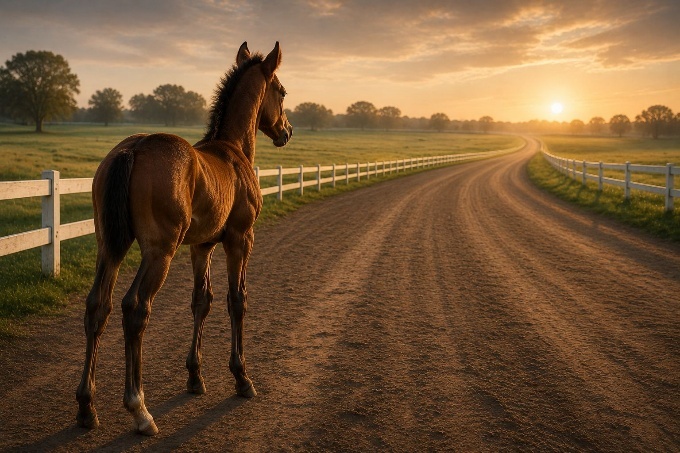
To me, each foal that wobbles to its feet and finds mom is the beginning of a long, complex story, sometimes good, sometimes less good, but, to me, riveting. Or I will pick up in the middle of a story at a yearling sale. For others, holding the winning Super Tri ticket that pays a colossal amount is a memory of a lifetime. Obviously, people are wired differently.
Who should we build for in our future?
The smart money probably suggests that harness horse racing should try to carve a niche for itself in the sports gambling and casino worlds. After all, jolt wagers have provided consistent gold for the companies that produce them. I don’t think our sport is built for that world. My longshot play would be on the long players in the stakes racing game, and even the long players in our gambling universe.
A harness horse race lasts two minutes. A horse’s journey lasts two, three, or four years. Sometimes much longer. It starts with a pedigree page in a sales catalog. Then comes the nervous bidding, the first training miles, the first qualifier, the first victory — or the first disappointment. Every owner knows there are moments when you wonder if you’ve purchased the next Hambletonian champion or should consider building a shed in your backyard for a new pet. That’s part of the adventure.
Modern gambling chases the immediate rush. Nothing wrong with that. But the rush disappears almost as quickly as the ticket is cashed, if it ever gets cashed. Stories linger. They give us someone to cheer for next week, next month, and next season. And I believe that the insane world we live in will, for some people, slow down, and those people will be searching for places to linger.
That may be one of the biggest opportunities for harness racing.
Instead of asking fans to fall in love with a random horse, on a random Tuesday night, perhaps we should invite them to follow 10 remarkable young trotters through an entire season. Invite them to purchase a small percentage of a yearling with you. Invite them to try fractional ownership. Let them meet fellow owners. Introduce the trainers. Show the setbacks, the veterinary scares, the miraculous recoveries, and the moments when an awkward youngster suddenly figures out what racing is all about.
Sports need stories long and short.
How many thousands of horses have you wagered on that were simply animals with numbers on their back? You never had the slightest attachment besides the finish line. The greatest teams, horses, and athletes become compelling because we know where they came from, what obstacles they faced, are facing, and what they stand to gain — or lose.
Maybe that’s the wager our industry should be making. Not another exotic bet. Not another gimmick. A bet that if we tell better stories, and hook them to the horses, people will care more deeply. They would celebrate victories and mourn defeats because, in some small way, those stories have become their own.
The biggest payoff in racing isn’t always found at the cashier’s window but in the next chapter.
A pari-mutuel wager asks who will win in the next two minutes? Stakes racing asks, who will become a champion over the next two years? Those are completely different emotional investments.
There is a psychological principle behavioral economists call the IKEA effect — people value things more when they’ve helped create them. Harness racing needs more versions of that.
We don’t want to end up selling the wrong product in our pari-mutuel horse races.
Maybe we should be selling journeys. The sell might not be as difficult as we fear.
Stay on top of all harness racing news.
Join the HRU mailing list, free.