





Nero, Scorpus, Diocles, and Crescens
More harness ghosts of the past.
by Trey Nosrac
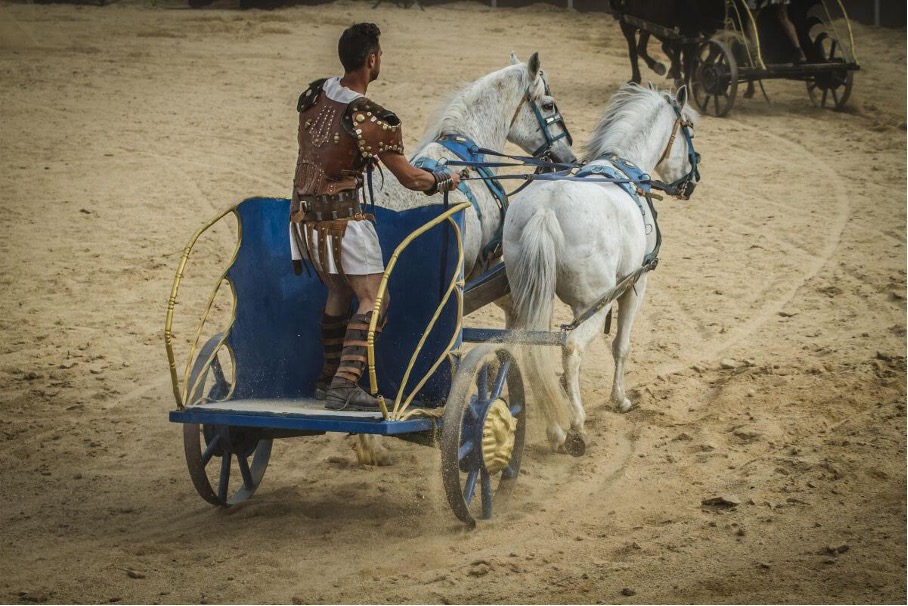
Two thousand years ago, chariot racing was the greatest game in town. The young men holding the reins could become richer than senators, more famous than generals. If you look at the graphic, the driver’s stance was surprisingly athletic, knees bent, and leaning back against the pull of the horses. A Roman driver essentially water-skied behind horses while standing in a lightweight wooden vehicle.
The number of horses in the team varied; a quadriga was four horses abreast. A two-horse, like the one in the graphic, was referred to as a biga. Three horses made a triga, and six made a seiuga. Drivers wore helmets, team colors, and a body wrap or padded tunic. The reins were wrapped around the waist for leverage, especially with three or more horses. They carried a knife to cut themselves free if they crashed. These races appear to be less like a jog around the track and more like a combat mission.
Let’s take a closer look at a few famous drivers who had unique stories.
From Oct. 13, AD 54, until June 9, AD 68, the Roman Empire was ruled by a chap named Nero. An interesting fellow, he was the fifth Roman emperor, stepson and heir to Claudius. Surrounded by a terrorized cast of sycophants, Nero kept busy with debauchery, extravagance, vengeance, and possibly the burning of Rome.
Nero had a bit of an ego and did not enjoy being upstaged. When the Olympics were scheduled in the year 64 AD, Nero entered the chariot races. The emperor did not appear to be a great athlete, more like a guy in a plus-size toga who would struggle to climb two steps to reach a banquet table for more wine and cheese.
Nero raced to the beat of his own drum. After a pre-race chat with the officials, he showed up on race day with 10 horses, far more than the rules allowed. When the race began, Emperor Nero managed to fall out of his chariot (disqualifying), had other people help him back aboard (disqualifying), and never finished the race.
Emperor Nero was a resourceful chap, so despite his efforts in the race, he declared himself the winner of the race, claiming that his mere participation was good enough. His forum quorum enthusiastically endorsed his victory. In fact, he entered several more Olympic events, won them all, and his records stood for a few centuries until they were permanently erased from the public record.
The greatest star of the Circus Maximus wasn’t an emperor. He wasn’t a senator. He wasn’t even a soldier. He was a chariot driver named Flavius Scorpus, a young man who won approximately 2,000 races before dying in a crash at age 27.
The young superstar built his reputation charging into the turns where races were often won or lost. The Romans even had a special word for the carnage that sometimes happened, naufragium, meaning “shipwreck.” The term originally described the destruction of vessels at sea. Race fans borrowed the word for the violent pileups that occurred when chariots clipped wheels, horses tangled, and entire fields collapsed into chaos.
Scorpus may have been Rome’s most beloved driver, but a chariot driver from Portugal, Gaius Appuleius Diocles, had longevity. During a career spanning a quarter century, Diocles competed in more than 4,200 races and won nearly 1,500 of them. He amassed a fortune so large that modern historians still debate how to translate it into today’s dollars.
Like modern free agents, Diocles was a bit of a mercenary who often switched factions during his career. One year he was a hero for the yellows, the next year he was for the reds. Two thousand years before professional athletes signed eight-figure free agent contracts, Diocles proved that speed, courage, smarts, and a knack for winning could make a sports star fabulously wealthy.
Crescens was cool. This chariot driver was a Moor from North Africa who became one of Rome’s leading drivers. He raced for the blues, stayed true to his team, and accumulated hundreds of victories. He was a notable exception to the class system; unlike politics or the Senate, he learned that racing cared more about talent than birth. A young man from the edge of the empire became a celebrity in Rome.
Knowledge about ancient sporting events is not easy to find, but Roman racing left a surprising paper trail. In addition to writing, tombstones, mosaics, inscriptions, bronze figurines, and even lead curse tablets (a tablet carried to wish bad luck on the other team) preserve the names of drivers and horses. In many cases, we know more about the careers of elite Roman charioteers than we do about medieval kings.
Tombstones and racing inscriptions are primary sources, especially for Diocles, who had people recording his race starts, wins, earnings, notable victories, and the patrons he drove for. It reads almost like a modern USTA statistical summary. Mosaics identify driver names, horse names, and victory scenes of drivers holding palm branches.
Hey, Yannick, Timmy, David, and Dexter — would you like to walk a mile in those sandals?
Stay on top of all harness racing news.
Join the HRU mailing list, free.