




Kristina Smith keeps horses and drivers safe
by Victoria Howard
When it comes to carrying on family tradition in the sport of harness racing, Kristina Smith ranks at the top of the chart.
Born in Milford, MA, her story and love for standardbreds began with Smith’s grandfather, whom she never got to meet, for he passed away when her father was a young boy.
The family patriarch’s name was Byron Smith, who was a leading driver in New England in the ’50s and ’60s.
Kristina was raised by her father Randy Smith and grandmother Linda Nelson.
Nelson drove in horse races primarily at the Maine tracks in the ’70s and Kristina’s great aunt, Phyllis Smith was the first licensed female pari-mutuel driver in North America and is in the Hall of Fame in Goshen, NY.

It’s quite a lot to live up to, but Kristina has held her own in making her family proud.
“My father started training a small stable racing at Plainridge Park, Rockingham Park, and several pari-mutuel and fair tracks in Maine,” Kristina said. “I learned a lot about training horses from my dad and my grandmother.
“When I was young, I worked at the barn with my grandmother and tried to absorb everything she taught me about caring for the horses and how to treat injuries. Both my father and grandmother were my two biggest role models growing up.
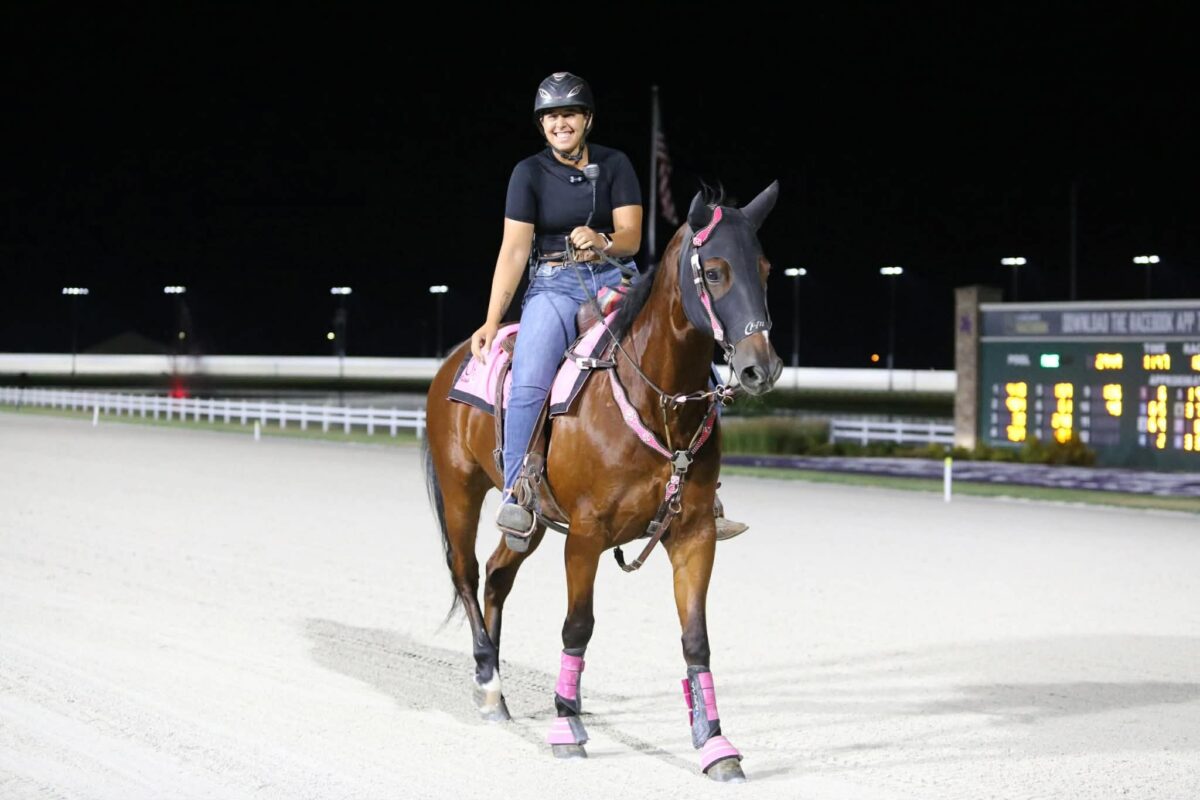
“I chose to be an outrider as my career, and I’m doing that today. Before that I owned and trained standardbreds which I truly love and admire.
“I guess you could say that Fancy Footwork was my ‘heart horse.’ I raced him through his 14-year-old year and then retired him where he is enjoying his time in the field. Fancy Footwork was actually the last Western Hanover sired horse to ever race. He always loved to race, and I couldn’t have asked for a better horse to grow and learn from.
“Today, I still drive a few horses in the summer at the fairs for my father. My favorite race that I look forward to every year is the ‘Family Race.’ A race my father and I put together which is held at the Greene County Fair.
“In this race everyone enters as pairs, mother/father, son/daughter. I think it’s a great way to support the families with generations in the sport. I still occasionally help my dad with a handful of his horses when he ships to Hoosier Park to race during the racing season.”
Do you have any horses of your own?
“I currently own four horses: three are ‘finished outriding horses.’
“Hank, my very first outriding horse, is a 23-year-old OTTB [off-track thoroughbred]. CoJo is a 15-year-old quarter horse, Bennett is a 9-year-old OTTB who was the first horse I broke to outride from scratch, and last but not least is Detective, a 6-year-old OTTB.
“They are all stabled at Harrah’s Hoosier Park in Anderson, IN where I am the outrider.”
How did you start off in your career and do you outride at any other tracks?
“I first started riding at a young age and got into the Riding Under Saddle Races for standardbreds in the East Coast. I raced my dad’s trotter Blue Boy Yankee at The Meadowlands, Vernon Downs, Ocean Downs, and the Cornish Fair in Maine.
“When we made the move to Ohio, I took notice of the outriders at the racetrack. I thought it would be a fun job and had a lot of riding experience. I actually caught several loose horses at the county fairs I was racing at on foot before outriding. I knew then it was what I wanted to do with my life.
“I started training to outride at Scioto Downs. From there I rode at both Hollywood Dayton and Miami Valley Gaming. I also outride at two county fairs in Ohio for their race days in the summer months.
“My father, Randy Smith, has been stabled at the Greene County Fairgrounds in Xenia, OH, for the past 10 years. Greene County’s Horsemen’s Association was the first track to give me the opportunity to pursue outriding, and I am forever grateful. Once I made the move to Indiana, I promised to always come home every year to ride at the fair.
“Last year I started outriding at the Mercer County Fair in Celina, OH. I have friends stabled there at the fairgrounds and it always is such a fun environment to be in.
What do you like so much about being an outrider at the fairs?
“I really enjoy getting to ride at a couple of fairs for a several reasons. It makes my job feel less of a job being around family and friends and is a great opportunity to slow down and catch up with everyone.
“I believe that fair racing was and will always be the ‘heart and soul of harness racing,’ for it is so much fun and everybody cheers on each other. It’s like one big happy family.
“Racing at the fairs also helps me stay diverse as an outrider, when riding on different sized tracks. I mainly ride at Hoosier Park which is a seven-eighths-mile track.
“Having the opportunity to ride on a half-mile track throughout the summer gives me a chance to brush up on a different riding style. On the smaller tracks things happen at a faster pace; less time and less room when things go wrong to execute the job.”
An outrider is a very important job but can be dangerous. What has been the most dangerous situation you have been in?
“As far as being in dangerous situations, yes, it is dangerous for you have to be alert every minute and watch every horse on the track and be ready to go if there is a wreck, loose horse or if one refuses to go behind the gate.
“There was one time at Miami Valley when a driver in the bike had a broken line. The horse was bearing into the light poles and put me in a tight situation to get everyone safe.
“Just last year I had a runaway at Hoosier that pushed me and my horse into the infield towards the fence surrounding the pond. I had to make a split-second decision to bail off my horse and hold onto the other horse as he dragged me through the fence into the pond with him. I was able to land under the horse and hold his head above water until more help arrived.
“I wasn’t prepared to go swimming that day, but you never know what situation you will be up against.”
Since it can be dangerous and you are a young woman with your whole life ahead of you, why do you do it?
“I do it because I’m able to give back to a sport and community that has given so much to me and my family throughout the years. Being able to be a lifeline and help someone in need is the most rewarding part of my job.”
Is there anything you would like to add about your job and your horses?
“I am fortunate enough to have a string of incredible outriding horses. The most crucial tool to have as an outrider is having a great horse. 80 per cent of the job is having a strong enough bond with a horse, that when you ask them to run into danger they do without hesitation.
“Horses are flight animals, and their natural instinct is to run away from danger. The bond that I have with my horses is something that is very special to me and I trust each of them with my life.”
Stay on top of all harness racing news.
Join the HRU mailing list, free.