




The nine lives of Mark MacDonald, Part 2
by Melissa Keith
Part 1 is here.
With Mark MacDonald returning to Woodbine Mohawk Park on Saturday (March 28), it’s timely to take a look at what led him back to Ontario. Originally, the 47-year-old driver was a trainer. Between March 1995 and Oct. 1999, he sent out 52 winners from 330 starts.
“You know what? It’s just timing,” said MacDonald, looking back on the evolution of his career. “[When] I was at Windsor [Raceway], I was young. I was literally driving in Ontario when I was 17. You’re not even supposed to be able to drive, [but] I got my license in Montreal and once I had my license, they had to let me drive. I was driving there for a few years and my own barn got really hot. We were doing some really good numbers, and I literally started to catch drive a little bit, which was shocking to me. I was having so much fun, I would’ve done it for free.”
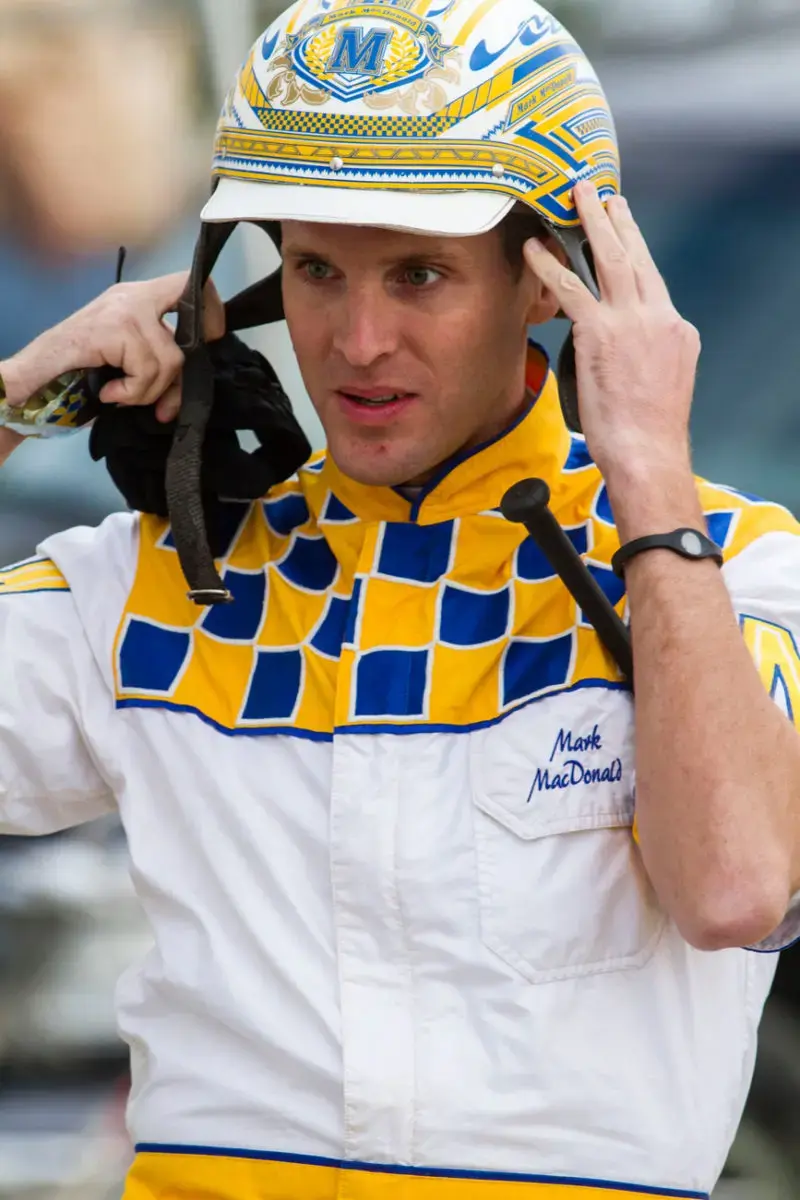
In a March 13 interview, MacDonald told HRU that two owners set him on the path toward early driving titles at Windsor (2000, 2002) and The Raceway at Western Fair (2003).
“Neal Moase was giving me horses and I was working for him,” MacDonald said. “I was training and driving for Neal, and I was literally making like 300 bucks a week and just getting like 10 per cent, living in a tack room, in Windsor.
“Frank Herold was an older gentleman who owned horses; his trainer’s name was Craig Hope. And this is just how life works out sometimes: Craig Hope was one of Bob McIntosh’s top trainers. I started to drive Craig and Frank’s horses. Frank only had a couple, and Craig was on his own.”
When Hope decided that he wasn’t busy enough, he announced that he was returning to work for McIntosh and recommended that MacDonald take over training and driving for Herold.
That recommendation, subsequently seconded by McIntosh himself, proved pivotal to the young driver’s career.
“Craig Hope really helped me out a lot… I don’t even know if he knows it,” MacDonald said. “When I started driving for Bob [McIntosh], I started driving world champion horses, qualifying world champions… When I was 19, I’ll never forget it: I think I had one or two drives on a Sunday night… My phone’s ringing in the afternoon. It’s Bob… I actually was in a wreck the night before with one of Bob’s horses [Peppermint Dolly] who jumped a shadow and went down [at Sarnia]. I kind of busted my knee up a little, but I was 19; I was fine.”
McIntosh asked him how he was, then asked MacDonald to drive a horse the trainer described as “the best colt in North America” in the June 27, 1999 Ontario Sires Stakes Gold final at Windsor. Intrepid Seelster (p, 4, 1:50.1m; $1,037,807) had finished second to Your Nemesis in his debut, the June 20 OSS Gold elimination.
“[McIntosh] goes, ‘I just want you to do your thing. You just drive him like you’re the [expletive] best, and you’ll win,’” MacDonald said. “And I’m like, ‘Oh, okay. I appreciate it.’”
Before he took to the track with 2-year-old Intrepid Seelster, MacDonald was awestruck.
“I’d only ever driven, like qualified, a couple of Bob’s better ones, but I ain’t never been in a situation like that before,” he said. “I just kind of let [Intrepid Seelster] settle and moved to the front, and he just run off.”
The colt won by five lengths over Your Nemesis in 1:53.3.
“I really started to get a lot of catch drives after that,” MacDonald said.
Before picking up momentum with McIntosh, MacDonald had already learned a lot from another, unrelated MacDonald.
“Mike [MacDonald] helped me more than anybody,” Mark said. “I went to work for Mike when I was 16. He was at Windsor that winter, and when the meet closed, we went back to Blue Bonnets [in Montreal]. Mike really polished me up. I was a little rough around the edges when I showed up in Windsor… He really gave me a lot of confidence. When I got my license, I got my qualifier, he was the one that wanted me to do it.”
Mike let Mark qualify 1995 Gold Cup & Saucer champion Sandy Hanover (p, 3, 1:53.3f; $261,223) on April 21, 1997 at Montreal, when there wasn’t a class for the classy pacer.
“They didn’t fill the open, so Mike says, ‘You’ve got your license, right?… Don’t worry about training that horse; I put him in to qualify for you,’” Mark said. “And I’m like, ‘Really? Okay… He’s an open pacer, right?’”
The rookie driver’s name appeared as “M. MacDonald” on the sheet for the qualifiers. He wore driving colors borrowed from Mike. Sandy Hanover’s owner, Emile Sylvestre, was surprised.
“Emile always wore long trench coats and smoked a big cigar,” Mark said. “He was a real cool guy. Mike is there in his jeans, smoking his pipe, and I’ve got my colors on, boots all shined up, ready to go. Emile came in the paddock and called Mike outside. He said, ‘Are you going to let the kid drive this horse?’”
Mark repeated the advice he got from Mike before Sandy Hanover’s qualifier: “’Listen: He’s not really quick off the gate, but don’t put him in the hole, for God’s sake. If anything happened, Emile will blame you, so just keep moving until he makes the front… Go a good mile with him.’”
Sandy Hanover won easily in 1:58.3.
On May 25, 1997, Mike also provided Mark with his first pari-mutuel drive. Although Naughtenoughfunds (p, 5, 1:56.1f; $88,737) finished sixth that start at Rideau Carleton Raceway, Mark unexpectedly drove to his first pari-mutuel victory at the same Ottawa, ON track on June 2, 1997.
“A guy from PEI, Donnie MacDougall, buys this horse and he’s got two big, bowed tendons,” Mark said. “He’s an old, classy horse. Donnie didn’t want to go to Rideau, and he says to me, ‘Hey kid, if you want to take that horse to Rideau and paddock him, you can drive him.’ I didn’t know what the horse was. Donnie had just gotten him. You’ve got to remember, this was 1997. Nobody had cell phones.”
With “no idea” about what equipment Make It Music (p, 5, 1:53.2f; $155,790) usually wore, MacDonald figured something out.
“So, I buy a couple of vet wraps and throw them on his front legs,” Mark said. “I jog him with the hobbles; they seem right, about 58 inches. [Make It Music] seems like a professional, like he knew what he was doing… I end up getting good cover, go three-wide, and he wins. I’m super-excited. Donnie shows up after the race. He got caught in traffic. He’s all pumped up and says, ‘What did you put on him for gear?’”
Make It Music had raced in the wrong equipment.
“When we got back to Montreal, I got the equipment card on him,” Mark said, adding with a laugh, “He wore a 55-inch hobble and a rolled-up shadow roll. I raced him with nothing, and he just jogged.”
They won again on June 14, before the pacer returned to his former connections.
Mark’s road to Mohawk followed a wide-ranging route across Ontario.
“Windsor would close in the summer, and just race on Sundays and Wednesdays, so I would do Sarnia on Saturday night and Thursday night, and Dresden on Sunday afternoon,” he said.
In summer 2003, Sand Olls Dexter (p, 8, 1:50.1s; $894,485) looked like a possibility for Mohawk.
“I drove him the whole summer at Sarnia, and he was just a beast,” Mark said.
After the meet, trainer Daryl Roberts asked where he wanted to race the horse next.
“I said I would love to go to Mohawk, but you know, there are steps you’ve got to learn,” Mark said. “I went to Mohawk one summer with a couple horses of my own and got my teeth kicked in. I wasn’t ready to drive there.”
Instead, Sand Olls Dexter went to Charlottetown in Aug. 2003, winning their first Gold Cup & Saucer together.
MacDonald relocated to London, ON as Sand Olls Dexter kept rolling at the Western Fair preferred level, only to experience what he called his “first major accident” there, driving another horse on March 1, 2004.
“Things were getting pretty good before that,” Mark said. “I was on a roll and was starting to really catch fire. Luckily, I was able [to] literally come back and drive at Flamboro… My jaw was still wired shut.”
He and Sand Olls Dexter won the March 8, 2004 London preferred 2, followed by the top class a week later. On April 3, 2004, they teamed up to win together at Mohawk, setting a course that took them to a second consecutive Gold Cup & Saucer in August 2004 and MacDonald’s 2005 USHWA Rising Star Award.
Stay on top of all harness racing news.
Join the HRU mailing list, free.



