



Reimagining harness racing
by Trey Nosrac
We chase purse money, worry about handle, debate fairness, and wonder about the future. We play a sport composed of many details and rules. We hope it endures for another hundred years. But for a moment, let’s look at a different lane. Let’s explore new ways to play.
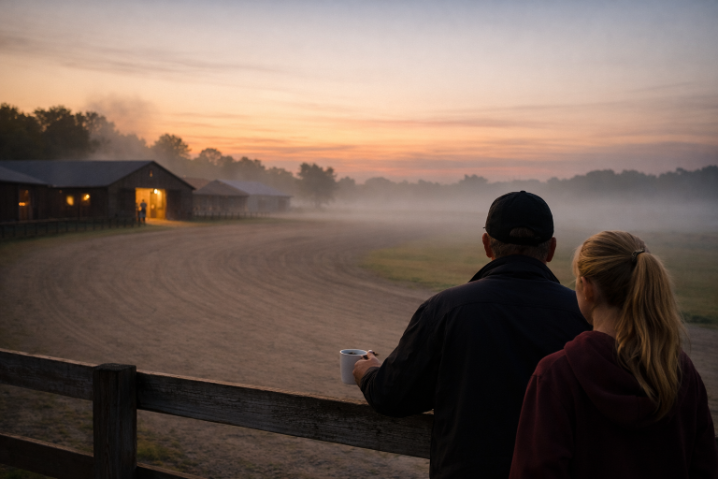
Imagine something closer to a country club than a racetrack. A place people gather because they are fascinated by the horses, the competition, and each other. Picture a Shangri-La tucked deep into the countryside where harness racing is a shared pastime built around participation. Barns are open, racing is simple, stories are shared, and traditions deepen. Additional activities and projects are a few steps away.
But who is actually going to build anything?
Maybe you. Consider this a nudge.
Some people seem to carry a gene that makes them wake up curious and restless – and then compels them to act. Benjamin Franklin gave us the lightning rod, bifocal glasses, and a new kind of stove. Thomas Edison delivered electricity, motion pictures, and more than a thousand patents.
Closer to our sport, consider Leland Stanford. In the 1800s, later in his life, Stanford discovered a passion for trotting horses. He set aside his pursuits in railroads and politics, including a term as governor of California, and built the Palo Alto Stock Farm. It was the most significant and finest horse operation in the world. Spread across 11,000 acres at its peak, the farm housed over 800 trotting horses, multiple racing ovals, and a staff of 150.
A modern version of that same curiosity type is Jeff Bezos. In his early public appearances, he radiated enthusiasm and possibility. He made people want to leap out of their chairs and build something. Most didn’t, held back by fear. One of his observations is particularly relevant:
“It’s human nature to overestimate risk and underestimate opportunity. We all stand at the edge of opportunities and hesitate because of all the ‘What ifs.’”
Another Bezos quote sharpens the point:
“If you’re starting something, make sure it comes from a place of curiosity, purpose, and long-term vision. Be a missionary, not a mercenary.”
As an outsider wandering through the harness racing world, it is undoubtedly possible that someone in our sport could be a modern-day Leland Stanford. Someone capable of building something more than a hobby, something exciting, something profitable.
One new way to play could begin with a controlled experiment – 110 horses of the same age, sex, and gait, trained, raced, and managed in a single location under a shared economic structure. The organizer will reduce costs through scale, coordination, and cooperation, and will preserve competition through team-based barns, a point system, and season-long performance metrics. No gambling is involved.
In this model, profit will be deliberately allocated to a select few. At the end of the season, a small number of horses finish economically ahead, not by luck, but by performance within a system of capped expenses and aligned incentives. This model is not a rejection of tradition, but an attempt to rebuild our foundation. It will be a league where participation is sustainable and winning is rare, yet real, in a community centered around our animals and our sport.
Impossible, you say?
In other corners of sports and entertainment, the “impossible” happens. Last year, Trey watched professional baseball players earn roughly $1,000 a month, attended a live theater production that employed 40 people, and clicked into the livestream of a professional fishing tournament.
The athletes, performers, operators, and audiences were glad to be there. These were not fly-by-night enterprises. They survived for decades because they embraced innovation, thrift, and belief. Management had a plan and made the dollars work. For all involved in these activities, the underdog mentality wasn’t a curse – it was fuel.
The show went on. The ballgame went on. The flopping largemouth bass tipped the scales on the presentation stage.
At this point, you may remain skeptical and say neigh. Comparison to off-Broadway theater, professional fishing tournaments, and minor-league baseball may feel misplaced.
However, those enterprises squeeze value from every imaginable revenue stream and lean hard into the passion surrounding their interest. Our sport can do the same. We can experiment with new models for an old passion. These models are not dependent on gambling or attendance. We can build a league of our own.
You may still be wondering where the money comes from. New revenue streams are not optional; they are fundamental. Every expense we currently accept as fixed can be mitigated, shared, or reimagined. Ownership models built on optimism and cooperation can uncover new economies and new growth.
So, let’s imagine purchasing those 110 young horses. Let’s hitch them to an ambitious experiment, detached from existing assumptions, rules, and habits. Let’s ask whether profit can be designed rather than merely hoped for.
Next week, we will have a few questions and prompts for creating a league of our own.
Stay on top of all harness racing news.
Join the HRU mailing list, free.