




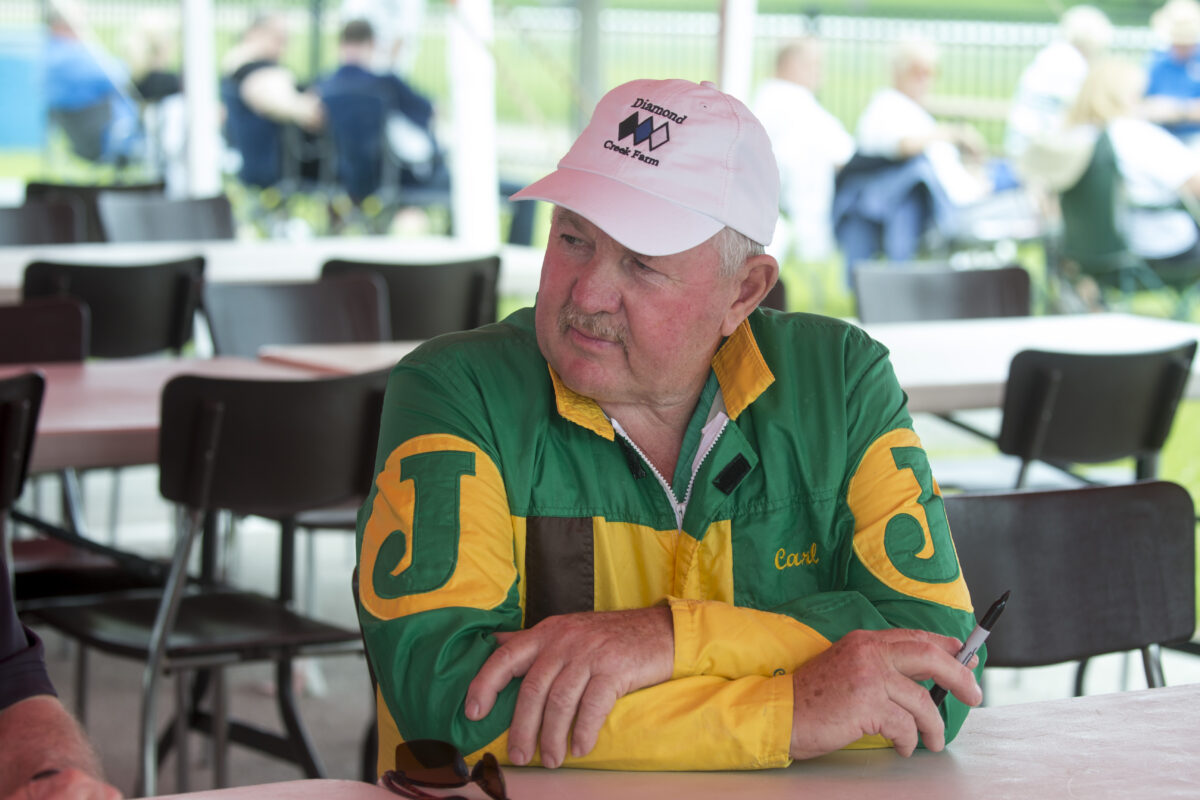
Carl Jamieson has thrived in harness racing by not taking shortcuts
by Murray Brown
When Jody Jamieson was asked what were the great life lessons that he has learned from his father, Canadian Horse Racing Hall of Famer, Carl Jamieson, he was quick to respond, “Hard work and honesty. There are no shortcuts in this life.”
It’s been a long route that Carl has traveled since 1986 when he and his family — wife Debbie, son Jody and daughter Brandy — left Nova Scotia to seek a better living in Ontario.
There have been several peaks and valleys since then, far more of the former than the latter. In 2006, he earned the O’Brien Award for Horsemanship to be followed in 2013 by the ultimate reward for a Canadian horseman, induction in the Canadian Horse Racing Hall of Fame.
Now 75, Carl has slightly curtailed his stable size from once a peak of 55 to presently a more workable size of 26.
It’s been a long road you’ve traversed since leaving Nova Scotia in 1986. What led you to leave a spot where you were at the top of your game to go to a fairly unknown destiny in Ontario?
“The sport in Nova Scotia was not doing well. The track in Halifax had closed. Truro was the only place where horsemen were able to race with any degree of regularity. Even so, the purses there were nowhere good enough for a man with a family to make any sort of a living. Harness racing in Ontario seemed to be thriving, certainly so in comparison with how things were in the Maritimes. I thought the time was right. I sold my farm, I packed up my family and my five-horse stable, and headed for Ontario.”
Where in Ontario did you start out?
“Back then, Flamboro was a thriving racetrack, not the equal of the then OJC [Ontario Jockey Club] tracks Greenwood and Mohawk, but a place where a good horseman could make a decent living, certainly a far better place at which to race than it is now. Only two of my five horses were good enough to compete, so I sold the other three and through the years I bought and developed others where I gradually rose to a level where I was able to compete, both at Flamboro and then at Greenwood and Mohawk. I soon realized that the best way for me to become competitive at the highest levels was to invest in yearlings and develop my own horses. So that’s what I did and have continued doing, ever since.”
Back then, you did it all, you not only trained and drove, but you also shod your horses, shipped them to wherever they were in to race, and did whatever work that needed to be done around the stable.
“Not a whole lot has changed since those days. The two major differences these days is that I don’t drive competitively anymore, and in the size of my stable. At one time it numbered 55, all of which I owned at least a part of. I grew up believing that hard work, with perhaps a little bit of good luck thrown in is what leads to success. Without both, to varying degrees, of course, you aren’t going to get too far in this business. As I’ve grown older, I’ve cut back some in the size of the stable. I soon realized that Jody could team one a whole lot better than I could, but could also compete with the very best drivers in North America, so I turned the driving over to him. It was a very simple decision. Firstly, because I realized that driving is a young man’s game and secondly, and more importantly, that Jody was a better driver than I was. Because of that, the horses would do better and of course so would the stable and I. It wasn’t at all a difficult decision to come to.”
At what point did you realize that Jody was going to become a top driver?
“I can’t say that I knew for certain that he was going to become great, but I knew that he had great natural ability and got along well with horses almost from the very first time he sat behind one. He has a wonderful ‘seat’ behind one. He has always been extremely comfortable when sitting in the bike. I’m a firm believer that great drivers are born, not made. In order to achieve greatness, you have to be born with that indescribable ‘it’ factor. You either have it or you don’t. If you don’t have it, all the teaching and experience won’t help you reach that level. If you do, then there are other things that come into the equation, such as hard work, experience and opportunity.”
Let’s speak of your present stable and how it is made up.
“I’d prefer to call it the Jamieson Family Stable. Jody is definitely a significant part of it, not only in doing the driving, but also in imparting his great natural ability with the horses. If our business can survive, I believe that Jody’s 16-year-old son Jett could have a future in it. Speaking of being a natural, I believe that Jett, can be as natural an all-around horseman as I’ve ever seen. But there is a long way from having natural ability and using it to become great at what you do. Right now, we have 26 horses in training of which 14 are coming 2-year-olds, five trotters and nine pacers. Most of the babies are Ontario-sired eligibles including a few by now proven sires Cattlewash, Bulldog Hanover, Muscle Mass, and a pair by first year trotting stallion King Of The North.”
You mentioned that you own at least part of every horse that you train.
“I very quickly realized that there is no money to be made in this business from just training horses, at least not from my experience in it. By being an owner, you are not only better off financially, but you are also in the position of guiding your own ship without too much interference from others. I’ve been in the fortunate position of having several long-time partners in my horses including, Larry Morrison, Tom Kyron, Blair Corbeil, and the late Brian Paquet. Speaking of Brian, not only did we own horses together for more than 25 years, but since his passing, his wife and two daughters have continued in being involved as owners with the stable.”
Let’s speak of some of the better horses that you’ve developed.
“I suppose that if we were speaking of good ones, the first was probably the free legged Run The Table filly Elegant Killean [$780,154], then followed in no particular order by Warrawee Needy [$1,258,627], Duke Of Abby [$944,694], Banner Yankee [$520,841], Up The Credit [$1,349,252], and a few other good ones. If you were asking for an achievement that I am specifically proud of, it is probably that I’ve trained and owned six Battle of Waterloo winners: 1998 Distinctiv Skeeter, 2000 CT Rocket, 2002 Village Blitz, 2004 Banner Yankee, 2006 Warrawee Ideal, and 2019 Sports Obsession. It would probably be seven, if a horse by the name of Beau Jangles had not been in with my colt Tilthecowscomehome this past season.”
What’s the best horse you’ve ever seen?
“I guess that most people would say it’s either Niatross or Somebeachsomewhere. For me it’s ‘The Beach.’ Here’s something that you probably didn’t know about Somebeachsomewhere. When the sheets came out, I was marked as the buyer of Somebeachsomewhere. Someone asked me about the colt I had bought. I had no idea what he was speaking about. I guess Brent Macgrath had never before bought a horse there, so he put my name down as the buyer so he wouldn’t run into any problems regarding credit. Looking back, I sure wish my name had stayed as the owner.”
You’ve received some notable honors in the industry, the first in 2006 when you received the O’Brien Award for Horsemanship, then the most notable in 2013 in being inducted into the Canadian Horse Racing Hall of Fame. What’s next?
“It has been kind of overwhelming for a kid from the small fishing village of Wallace, NS. I never would have dared dream of such achievements. You ask what’s next? I’m fairly certain that before too long, when Jody becomes 50, the age of eligibility for the Canadian Horse Racing Hall of Fame, that he will strongly be considered for entry. I very much look forward to that day.”
Stay on top of all harness racing news.
Join the HRU mailing list, free.