






Racing funambulists
by Trey Nosrac
To highlight my never-ending volleys of follies, allow me to present a joyful, accurate report concerning a harness racehorse that struggled to stay on stride. After recapping this wayward trotter’s exploits, I will suggest a few unusual races for race secretaries to write.
During the summer of 2024, I closely followed the racing fortunes of a 2-year-old filly trotter owned by an acquaintance. I watched and wagered on every one of her races. As a 2-year-old, this filly went behind the gate 10 times. She broke stride seven times. The few times she did not break stride, she raced well for significant mile segments. Once, after breaking stride and spotting the field about 50 yards, the filly restarted and trotted up a storm to grab a minor check.
This fumbling filly did not seem to have a pattern. This lovely trotter went off-stride before the gate, with her nose on the gate, at the quarter pole, at the half, at the three-quarters, in the lane, and possibly in the trailer hauling her back and forth across the state. The frustration of walking this tightrope for the owners and trainer of this filly was akin to trying to solve a Rubik’s Cube blindfolded.
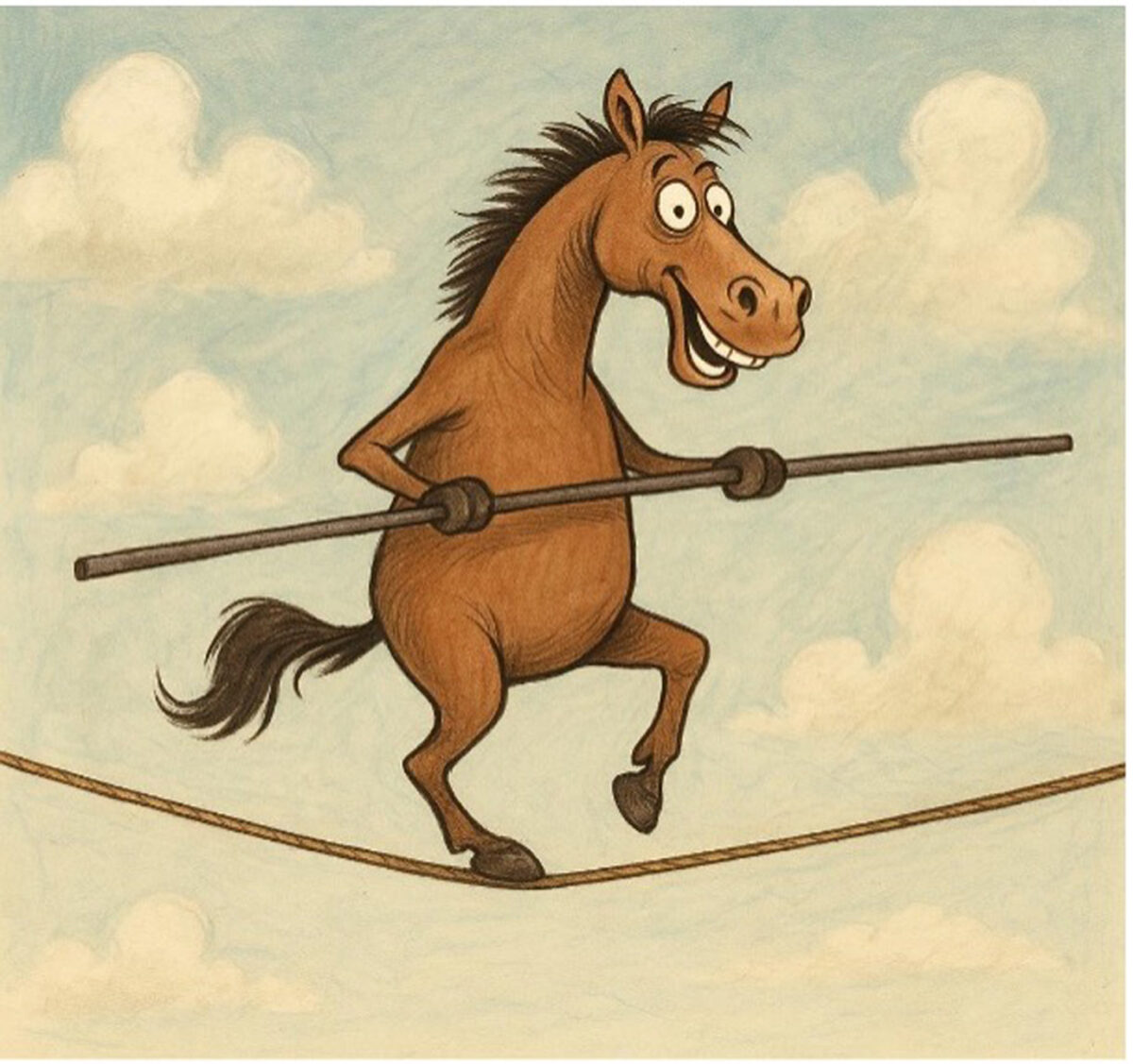
For me, following this fractious filly was fun. Watching a racehorse that constantly goes off-stride is like watching a funambulist. Funambulist is a fancy name for a tightrope walker. Every step of every race she competed in was like watching a man on a high wire cross Niagara Falls. There was drama with every step. Owners, gamblers, friends, and trainers all watched each race of this filly with our hearts racing, muttering, “Keep at it, keep at it, c’mon.” We felt great emotion. We should harness this emotion.
My philosophical, and perhaps preposterous, idea is that if you step back and look at a race objectively, a racehorse likely to break stride at any second will add to the drama of any race. Simply hoping that the horse you chose to wager on does not jump off-stride is an asset we could monetize.
Every year, my plea to the public is to monetarily reward trotters and pacers who dare to race without hopples to enhance the magical sight of a horse in motion. While I remain a minority voice for free-legged-ness in our horses, let me suggest another type of race that is a close cousin.
Give me control to create a new harness race, and I would arrange something like this: trotters, eight starters, all on the gate, post positions seeded by ability, 5-year-olds and under, and bonus money for racing without head poles or hopples. Forget about requalifying after a few breaks; one flat line per season will be the ticket to racing paradise. The condition sheet would look something like this:
•The Treadlightly Trot — for fillies and mares with lifetime earnings under $5,000, ages 2 – 5, with more than six pari mutuel starts and less than three flat lines. This race is open only to trotters that statistically have a less than 50 per cent chance of remaining on-stride. Horses on the stewards’ list are eligible. Purse, $6,000 (added money for subtracted equipment). State-bred preferred.
That race has drama. A race of this ilk will give plenty of room for mayhem and make it much easier to follow your horse during the mile. There will rarely be a single-file conga line. There will be horses everywhere on the racetrack. A race like this is much more playable for a pitiful handicapper like me.
Betting conglomerates, computer programmers, and serious handicappers will avoid this race like the plague, leaving it to those of us who are less sophisticated gamblers. Trip handicapping loses some power when half the field runs. Merely staying on-stride and trotting down the lane might win the day. Your horse is never out of a horse race of this construction because a right turn into the parking lot or a left turn into the infield is never off the table.
Keep your smooth striders, your racing to form, your deep thinking, your obsession with speed, and statistics. Bring on the mayhem, chaos, disorder, and madness, where the smiles lurk. Advertising offbeat races, like the one above, would be marketable because they are dramatic and unique. The fun crowd can look forward to holding their breath for two minutes and three seconds, or more, every step of the way. Trainers and owners with a mistake-prone entry would always have hope that good manners get rewarded.
P.S. — At age 3, the breaking filly that inspired this column evolved into one of the finest and steadiest trotting fillies in the state
“A well-developed sense of humor is the pole that adds balance as you walk through the tightrope of life.”
Stay on top of all harness racing news.
Join the HRU mailing list, free.



