



Looking back at my first Hambletonian as I prepare for my 58th straight
by Murray Brown
The 100th edition of The Hambletonian will take place Saturday (Aug. 2). When this missive appears, the final fields for both the Hambletonian and its sister act the Hambletonian Oaks will have been determined (after I filed).
It will be the 58th successive Hambletonian that I have been privileged to attend. I’m far from certain that I will make it for many more, but I’m fairly confident that I will be in the stands on Saturday.
Sometimes, the race itself takes place on my birthday, as it did last year. This year, my birthday comes that day after the race. It will be number 84. There are not that many more trips around the sun remaining for this guy. Please permit me a few reflections of The Hambletonian then and now.
I have written in HRU about all the Hambletonians I’ve been to prior to last year’s event: Part 1, Part 2,Part 3.
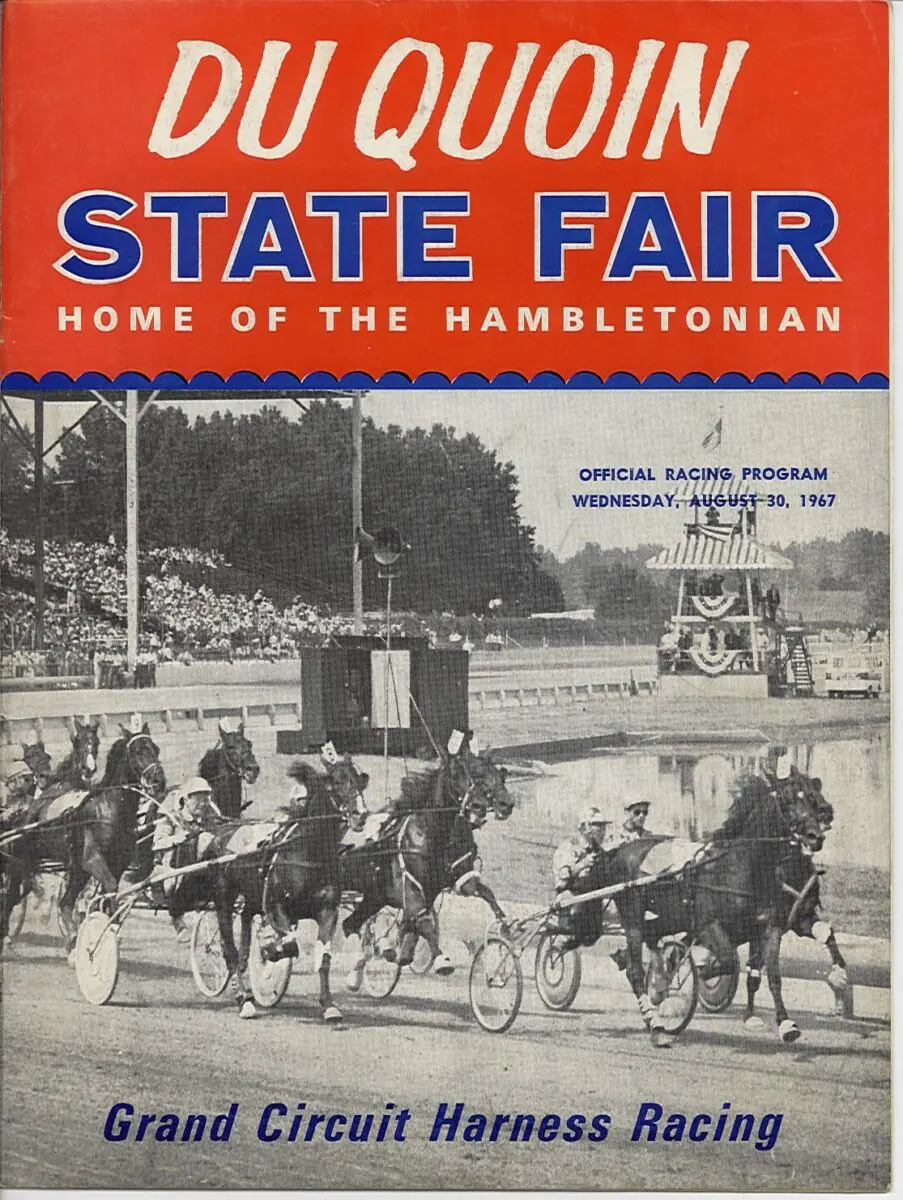
The first Hambletonian I went to was in 1967. I was enthralled. It is no reflection on The Meadowlands, whose people have done a marvelous job in their stewardship of what then was called “America’s Greatest Horse Race.” To these eyes it was just that. It was reminiscent of the Little Brown Jug to which I had first gone in 1962. It had the rural country fair atmosphere of Delaware, OH, but was situated in a far more remote part of this vast country. DuQuoin, IL, at the time was best known as the home of the legendary pool player Minnesota Fats (née Rudolf Wanderone) made famous by Jackie Gleason in his role in Paul Newman’s great movie The Hustler.
Another claim to fame of DuQuoin was that it had a large Coca Cola plant owned by the Hayes family, who also ran the Fairgrounds and the great race. I was among the few fortunates who were not concerned about how to get to DuQuoin. The nearest town is Carbondale the home of Illinois State University, a place I knew of as where Walt “Clyde” Frazier first displayed his basketball wizardry. The metropolis of St. Louis, MO, is an almost two-hour drive away.
Lucky me. I got there on a private plane, a Kingair, N48W, owned by Hanover Shoe Farms and piloted by Gene Harvey. DuQuoin wasn’t big enough then to have its own airport, so we flew into Carbondale and rented a car. En route, we passed a beautiful home. I was told that was where Minnesota Fats lived.
We arrived there on the eve of the draw for the race. The Hayes family hosted a barbeque to coincide with the draw. Just about all the people who were in town for the race were there.
The race itself was no surprise. It was dominated by the Frank Ervin trained duo of Speedy Streak and Speed Model. The favorite, Speedy Streak, won it and his stablemate, the filly Speed Model, finished second. Ervin was in the hospital after undergoing surgery. He elected Del Cameron to drive Speedy Streak for Cameron’s third win in “America’s Greatest Horse Race.” The filly was driven by Arthur Hult, Ervin’s assistant. K.D. Owen, the owner of Speedy Streak along with Clarence Gaines, finally had his Hambletonian winner after being deeply disappointed with overwhelming favorite in 1965. An added irony is that Del Cameron who won the race for him with Speedy Streak was also the driver of Egyptian Candor who won the race in 1965 and defeated Owen’s Noble Victory.


I went on to see the remaining 13 races in DuQuoin, until the heart-rending finale in 1980 when Burgomeister, the horse that Peter Haughton had owned with restauranter Marcello Fiorentino, won under the guidance of Haughton’s father Billy.

Then the race moved to The Meadowlands where it still resides.
In between, I feel obliged to recount a tale where I was the proverbial fly on the wall.
There were two entities involved in the bidding for the hosting rights for The Hambletonian. They were the DuQuoin State Fair and Liberty Bell Park. There was a lot of animosity involved in the bidding and the granting rights for the race. Surprisingly Liberty Bell Park won with what I was told was a one-vote margin. For a reason that now in retrospect seems somewhat trivial, the race never took place at Liberty Bell. The reason given was that the Liberty Bell management, for whatever reason, decided that they wouldn’t open its mile track for training two weeks before the race as called for in the contract. That might seem trivial, but it was a common practice for horsemen to ship to DuQuoin in that time frame and to train their pupils on it well before the time when they were to race. Two examples of horses that I know did so were Timothy T and Speedy Crown. The Liberty Bell folks stuck to their guns, but so did the directors of the Hambletonian Society. Bidding was reopened. The two main bidders were now The Meadowlands and DuQuoin. Of course, The Meadowlands won.
Let’s go back to a day or two following that first monumental vote. Four of us were having dinner at the Penn Harris Hotel in Harrisburg, PA, on the eve of that year’s Harrisburg sale. There was Max Hempt, Delvin Miller, John Simpson and myself. I don’t recall how I found myself with those three great Hall of Famers. I suppose that I was just there because Simpson invited me along.
There were two very strongly antagonistic camps at that dinner. Miller was a strong supporter of the Hayes Family and DuQuoin. They had long been great supporters of him and his stable as well as being great friends. Hempt and Simpson were Pennsylvanians who felt that the race was lost in the hinterlands of Illinois. Miller was of course a Pennsylvanian as well, but his support of his friends overtook any allegiance he had for the state in which he resided. All three were, and had been, the closest of friends before that fateful dinner.
As I recall it, the discussion involved the fateful vote. Miller was still very upset with its result. I don’t recall exactly what was said, but Miller’s well-known temper boiled over. He took the cloth napkin that had been resting on his lap, threw it and hit Hempt in the face while saying some unspeakable words. He got up and left the table. There was absolutely nothing funny about the incident. But in retrospect, reliving it is almost comedic. The sight of the relatively small Miller in effect attacking a giant of a man in Hempt now brings a smile to my face. Needless to say, all three of us were in shock. As for me, I wanted to crawl under the table. A testimony to the long lasting Hempt, Miller friendship, to my knowledge, it was shortly thereafter that the two lifelong friends made up and the incident was quickly forgotten.
Here are two other examples of Miller’s temper. As John Simpson would say about his lifelong friend: “Delvin was quick to boil over, but also quick to forgive and forget.” Miller received the good guy award from the U.S. Harness Writers Association. As he was up there receiving his award, Ed Daugherty, the boss of Liberty Bell who was at a neighboring table said, “I didn’t vote for the son of a b—-.” Miller heard him and got off the dais and took a swing at Daugherty. Another time Max Hochberg who owned Torpid was heard to say that Torpid would become a better sire than Adios. Miller, invoking the horseman’s credo of “you can insult me, you might even insult my family, but you had better not insult my horse,” heard of Hochberg’s perfidy and sought him out and took a slug at him.
On to The Meadowlands. It was 1981. Harness racing at The Meadowlands was like it had never been before, and, sadly, will never again be. Bob Quigley was the greatest general manager that a harness track has ever had. Quigley was not only the best, but his supporting staff, including its director of racing Joe DeFrank, was the best ever assembled. Everything leading up to the race could not have been better. There were two items that in effect spoiled the show — one that was man-made, the other that was not. For some short-lived period of time, admission was charged for the event. Not only was admission charged, but the price was high. In my less than perfect memory, the number $20 comes up. It was probably less. But $20 in 1981 was a lot of money. The second was the weather. The day began with rain. It rained throughout. The race was contested in a quagmire won by longshot Shiaway St Pat. Of course, the conditions affected the turnout immeasurably. All the plans including family functions like kiddies’ pony rides and amusement park rides had to be shelved.
It’s now 2025, year 100 of, at least to me, America’s Greatest Horse Race. The crowd which once bordered on 30,000, will likely be somewhere between 10,000 and 15,000.
It shapes up as a highly competitive one. Again, I filed this before the eliminations were held, but I see four main competitors. They are, in alphabetical order, Emoticon Legacy, Go Dog Go, Maryland, and Super Chapter. Who do I like? Assuming they all get there on Hambletonian Day, I like Go Dog Go, followed by Maryland, Super Chapter and Emoticon Legacy. But don’t bet your last dollar on my choices. There was a time, a very long time ago, when I prided myself on my handicapping skills. Those days are sadly long gone.
Stay on top of all harness racing news.
Join the HRU mailing list, free.