







Don’t sell Dan Fisher short, there’s more there than meets the eye
by Murray Brown
A little while ago I was moaning out loud that I’m finding a dearth of people to profile in this column. I’ve now written nearly 300 weekly columns for over five years in what was supposed to be a part-time gig giving me something to do in retirement. John Rallis, whose acquaintance I had just made, happened to overhear me and piped up: “Why don’t you do a story on Dan Fisher?… Dan’s story is a remarkable one that needs to be told.”
Yes indeed, Fisher’s story is remarkable, except I have doubts that I am able to do it justice.
I’ve known Fisher ever since he began selling advertising for TROT Magazine in 2006, but there was so much about him that I didn’t know.
For one, I had no idea that he had been, and still is sometimes a horse trainer, well before he started working at Standardbred Canada.
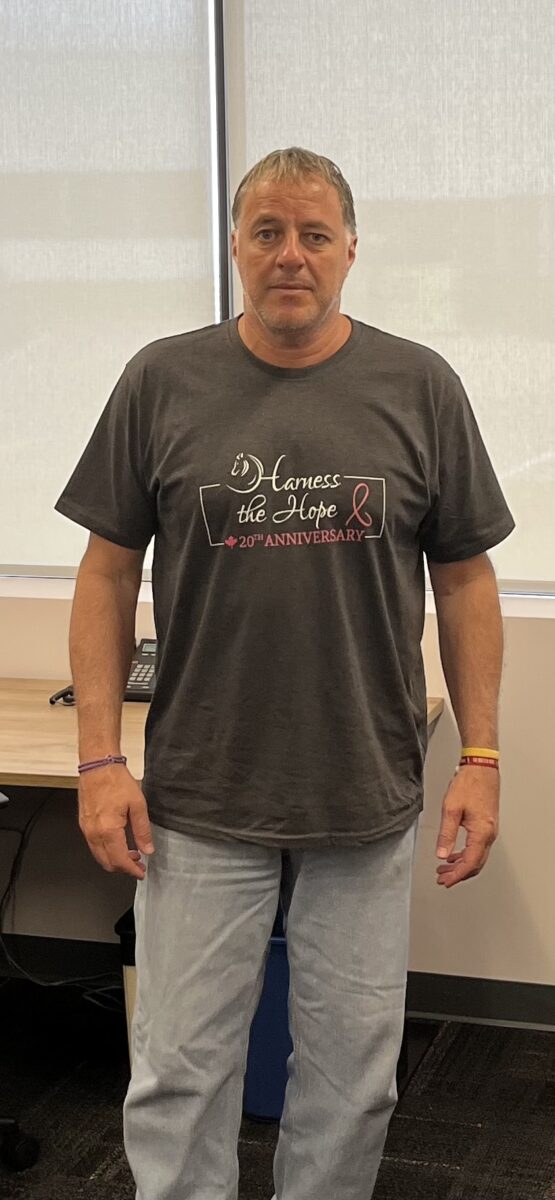


Let’s start at the beginning Dan. How were you introduced to harness racing, more specifically where and how did you start training horses?
“My dad was a doctor, but he was also a part-time horse trainer and driver. My parents built a small farm on 20 acres in north Pickering and put in a small track that was just over a quarter-mile long — we moved there when I was 4 years old. We always raced a few horses off of it, mostly at the “B” tracks. He’d jog them before going to work in the morning and my mom would put them away after he’d leave. I started jogging them by myself at age 8 or 9, probably. By the time I was in my early teens I was training. Trust me, if you could train a horse beside another one, and get around the turns on that track — fishtailing — then you could get one around any track. We’d go four laps — eight turns — as a mile, and I had the track record with Bio Latka in 2:29. That was flying. Most of our horses were ordinary, but we loved them, and my dad did have a number of driving wins, too. We did have one pretty good trotter that raced mainly on the OJC [Ontario Jockey Club, now Woodbine Entertainment Group]. His name was Coalhoun. I remember he bought him as a weanling for $800. He took a record of 2:04 at Garden City, when that meant something, and went on to earn $63,105.”
Then you went on to university, as you say, ostensibly to play football.
“I played a lot of sports at a decent level growing up. I played some tier two Jr. A hockey, and on an OFSAA championship rugby team in high school, but football was probably what I was the best at, I guess. At Pickering High, with two years of high school remaining, our assistant football coach, Coach Martini, who had played in the CFL, told me and my good friend Marco — who owns some horses with me all these years later — that if we forgot about playing basketball in the winter and concentrated on working out with weights, he felt certain that we could play football at the university level. We both took his advice. I ended up playing five years as a tight end at the University of Ottawa, and Marco eventually got drafted by the Argos. One of my proudest moments at Ottawa came when, as a senior, my teammates voted me in as a team captain. That still means the world to me. While I was away at school, I still had two horses, my favorite at the time, Bio Latka, and another lower level claimer named Iona Master George. In Ottawa, I had a teammate, Gordie Weber, who also liked harness racing. Gordie had a car, and we would sneak off to the races at Rideau Carleton on the eve of games, when we had a curfew and were supposed to be home resting. Lucky for us, we were never outed, because there was no chance we’d run into anyone there that we knew. Gordie ended up playing in the Canadian Football League (CFL) for four or five years, but my football career ended, in essence, when I tore my ACL. There wasn’t time to have it reconstructed before my senior year, so I used a brace and played without one. I have zero regrets, though. I’ve had multiple surgeries on many body parts, and my body is generally sore to this day, but the memories are incredible, and playing team sports prepared me more for life than anything else.”
After university?
“Once I was out of school, all I wanted to do was train horses, but there was a pressure to use my degree to my advantage, so I got a job as an Ontario sales rep for Umbro Canada — known as ‘The Soccer Company.’ But my boss at Umbro was also my high school girlfriend’s older brother, and we had always wanted to get some horses together. The Umbro job was really only enough to keep me busy part-time anyway, so we also got a few stalls at Greenwood and we claimed a mare named Jillian D. She was second for us in her first start but we lost her, so the next week we claimed the mare that had beaten us, Daylon Touchdown, and we raced her successfully at Greenwood and Mohawk for the next six or seven months. I was off-and-pacing, so to speak, in both professions.
“Umbro was based in New Westminster, BC, and that’s where I met my eventual wife, Patti. She worked at Umbro head office at the time, but I kind of stole her from them. She eventually moved east, to be with me, a few years after we met.
“My stable was having a little success and started getting bigger. Umbro was booming and after about two-and-a-half years of doing both I had to choose one. It was easy — I chose the horses. My mom said, on a few occasions, ‘If you were just going to train horses, why did you even bother going to university?’ But she always knew it was the horses that I loved, because she loves them just as much, if not more than I do.
“As far as Patti went, she had never been around horses before she moved here, but she began helping around the stable and learning from me, and she fell in love with them immediately, too. Eventually, through the years, she worked, rubbing on horses, for Rick Fife, Kevin Davidson and John Kopas.
“A little over three years after Patti moved here, we had a son, Justin. When he was 2, we bought a house in Cambridge, that a horse I did well with — on a deal — paid the mortgage on for about the first two years. His name was Immaculate Concept. He was only at the non-winners of two level when I took him on for a promise of 50 per cent of his earnings, but we went all the way up the class ladder with him until we actually beat Western Ideal with him one night at Mohawk.
“Life was pretty good, but when Justin was only 9, the worst thing happened — Patti was diagnosed with leukemia. That’s where harness racing and our amazing community of people came in. Everybody, and I mean just about everybody, was beyond helpful. The horses were well taken care of when I couldn’t be there. A good friend, Haris Galatsidas, came to the barn every morning and helped me for free, for at least the first three to four weeks, until I was able to start paying him a bit. Patti’s illness had imposed a severe financial strain on us, and Patti’s good friend and teammate, Joanne Colville, and their softball team made up of horsewomen, spearheaded a big fundraiser at a place near Mohawk we called The Rockpile. It was an incredible night that Patti had been released from hospital in time to attend, but one specific thing from that night still stands out in my memory. A 50/50 raffle took place and about $800 was won by Rob Fellows. To us that was a lot of money, and Rob, who I had once been stabled beside for a few years, proceeded to hand the money to Justin. The thought still makes me a bit emotional to this day. That was only one of many acts of caring by many members of our community that helped us through that incredibly difficult time. There’s that saying that says ‘It takes a village’ — our village was the harness racing community.
“Patti battled the leukemia valiantly for six months, and we got her into remission. But shortly after a celebratory trip that the three of us took to Florida, she relapsed, and before they could find a match for an imperative bone marrow transplant she succumbed to that horrible illness. Needless to say, both Justin and I were devastated. Here I was, now a single father, responsible for not only providing a living for Justin and myself, but also for raising this precocious and heartbroken child.
“Justin, now at the age of 10, was heavily involved in both competitive baseball and hockey, and I was coaching hockey as well. I usually worked from 6:30 a.m. until 1 or 2 p.m., but school didn’t start until 9 a.m. I sometimes raced at night, but he had to be taken to games and practices, and then had to get to bed at a decent time. I had purposely kept a small stable, partly because I was a bit of a perfectionist with how I did things, but mainly because I wanted to be a hands-on father when that day came. Ironically, from reading TROT while growing up, it seemed that the one regret most horsepeople had was not being around as much as they’d wished to see their kids grow up. I always knew that would never be me, but now I actually had no choice — I couldn’t possibly continue training horses for a living and raise my son the way his mother would have wanted him to be raised.
“I had applied for the position of director of advertising at TROT a few weeks before Patti passed away but I never told her about it. I didn’t want her thinking that I was preparing for life after she was gone. They eventually told me that all the other applicants were either professional salespeople with no horse racing knowledge, or horsepeople with no sales experience. Apparently, I checked all the boxes and they offered me the job.”
What was it like being a single father?
“It wasn’t easy, especially at first. Looking back at that first summer, I honestly have no idea how we got through it. My first day at TROT was his last day of school for the summer. I had to be in five days a week then — there was no such thing as working from home — and I had a broken-hearted 10-year-old to take care of. My boss, Darryl Kaplan, was a godsend. He told me to do what I had to do for my son at all times, and if my work was completed at 3 a.m. it didn’t matter — as long as it was completed. With the help of my new job and some family and friends, we somehow got through that summer. Justin had just made the travel baseball team in Cambridge as well at that time, and the ball schedule wasn’t a light one, but a couple by the name of Tim and Cindy Ruf, whose son Travis was Justin’s good friend and teammate, came through in a big way for us. Without Tim and Cindy, I’m not sure we would have gotten through that first summer. The world really is full of good people.
“I kept playing beer league hockey, on horseman’s teams, and was able to continue coaching hockey as well. And for Justin’s final two years of minor hockey, and another eight years afterwards, horseman Nick ‘Ralphie’ Boyd and I coached Midget AA hockey together here in Cambridge. Those years, working with 16-to-18-year-old young men, were some of the most gratifying years of my life. Ralphie and I built so many great relationships with those kids, some that have lasted to this day. I really loved giving back, after some of my coaches did so much for me while I was growing up. It was much of what I learned from them that helped me get through a number of trying years as much as anything. Ralphie and I stopped the coaching, unfortunately, after the first year of COVID, but after 19 years I’m still going strong at TROT.”
You are still there, but your position itself has changed somewhat significantly.
“I was hired to be the ad salesman for both the magazine and the SC website, but after a year or so I asked if I could be more involved with editing and content development as well. As a lifelong horseperson it drove me nuts if the terminology in some of the pieces wasn’t exactly what it should be, and as far as developing interesting content, I knew so many people in the business that I became more important to the publication in that regard also. In 2019, after we had been without an associate editor for a number of years anyway, Darryl Kaplan was appointed SC’s manager of information and innovation. The magazine had consisted of only Darryl, myself and Sue Longley for a number of years at that point, so I was basically the associate editor at that point already — just not in title. They offered me the role of editor but I refused to give up the ad sales because I just believed that my great relationships with our wonderful clients was too important to the association. I accepted the title of managing director, and for the past six years I’ve been running the magazine in its entirety. TROT recently turned 50-years-old, is doing great, and I’m extremely proud to have played a small role in that.”
Let’s switch gears and talk some about horses, more specifically those that you’ve trained and more recently bred and raised. Do you have a single favorite?
“That’s a very tough question because I loved many of my horses like they were my children. Bio Latka was the first one I owned part of — when I was 16-years-old — and I learned so much from him before retiring him and finding him a home-for-life through OSAS [the Ontario Standardbred Adoption Society], but if you insisted that I was limited to only one, that one would probably have to be Chris Seelster. We had lost a good claimer we had and we wanted to buy something privately, so I bought him for $30,000 — all the money we had — when he was racing somewhat uncompetitively in the non-winners of two. He was an incredibly beautiful 4-year-old stud by Threefold, but it turned out that he was a bit crazy. I loved to treat my horses like horses though — not like robots. I was a decent-sized guy and I liked to rough-house with them a little. He would bounce up-and-down on his hind legs right beside me every morning as I’d put him in the crossties. He refused to turn on the racetrack, too. He needed the parade marshal to turn him to go to the gate on race night. If you ever wanted to go a training mile with him you needed to get another horse on either side of you to help you turn — and even that didn’t always work. So, I never trained him — no big deal. He had never beaten 1:56 when we bought him though, and in his second start for me he jogged, for Paul MacDonell, in 1:53. I raced him near the top level on the WEG circuit on-and-off for three years and he was the first horse that helped get my name out there. We even reached the free-for-all level at Mohawk and raced in the Labatt Pace at Western Fair. He was an unforgettable animal and there’s a huge action shot of him hanging above my bed.”
In recent years you are still involved with horses, not in training them, but in owning parts, breeding them and in selling their yearlings.
“I’m still a little involved in jogging and training a few as well, but only with one of my own — Market Banker, who I own in-part with my parents, and my good friends Marco Arbour and Chris and Camilla Christoforou. I really have the best of both worlds now though, as I live only about five minutes from Classy Lane Training Centre. Whenever I get the itch, I can call my friend Chris Christoforou or Tony Beaton, and they always welcome me out to help train or jog. I really get missing being around the camaraderie of the barn at times, and the horses, and when I do I can just pop over and help. Every time I race bike one though, all the clowns at Classy Lane think they’re funny and yell out to us that it must be ‘Stifle Day.’
“I got into the breeding business with my friend Tom Grossman of Blue Chip Farms a number of years ago as well. My old owner — Gerry Haggerty — and I had a decent Bettors Delight mare, Peppermint Patti, that we had named after the human Patti. Tom and I own her together now and when she has a foal, Justin and I name them, invariably to have some connection to his late mother. I got a taste of the travails involved in the breeding game early on though. We had a Huntsville colt of her that we had decent expectations for, but that year the sale was held in Timonium because of COVID. He was selling on the third day and it had been cold, wet and miserable. He only brought a disappointing $10,000, and then, the very next day, her weanling filly by Hes Watching coliced and died. The mare somewhat made up for it in the 2022 Harrisburg Sale though, when her Huntsville colt, Vandiemen Bluechip, brought $40,000. He’s been her best foal, and now has a record of 1:49.3 and has earned $334,935. He was fifth in the Graduate final the other night, paced his mile in 1:48.1, and we’re selling his full brother in Harrisburg this fall — Blackfoot Bluechip. Fingers crossed.
What is your son Justin doing these days?
“It’s hard to imagine but Justin is now 29. He still loves sports, including harness racing, but the one he’s best at is golf. It took him a number of years to beat me, but now he’s a three or a four handicap, so my days of beating him come few and far between. He graduated from the University of Ottawa as well, during COVID unfortunately, and then worked as a groom for Tony Beaton for a while. After working in the Mohawk race office for a few years, now he also works at Standardbred Canada, but in a different department than mine. He has dabbled in horse ownership as well, although it might be hard for him to beat his first experience at it. I had purchased 20 per cent of an Archangel yearling that Shane Arsenault had bought in 2017. His name was Knight Angel. As a Christmas present to Justin, I gave him 5 per cent interest in the colt, and he turned out to be pretty good. He was an Ontario Sires Stakes Gold winner at both 2 and 3, and at 2 he actually beat Forbidden Trade in the Champlain Stakes. Imagine that, the first horse that you’ve ever owned and he defeated a future Hambletonian winner. Justin was pretty proud of that and he wasn’t shy to tell people either. At the end of the day though, my son is just a really good human being. That’s what I’m the most proud of, and that’s exactly what his mother would have wanted.”
Stay on top of all harness racing news.
Join the HRU mailing list, free.