







Gambling action throughout the ages
by Trey Nosrac
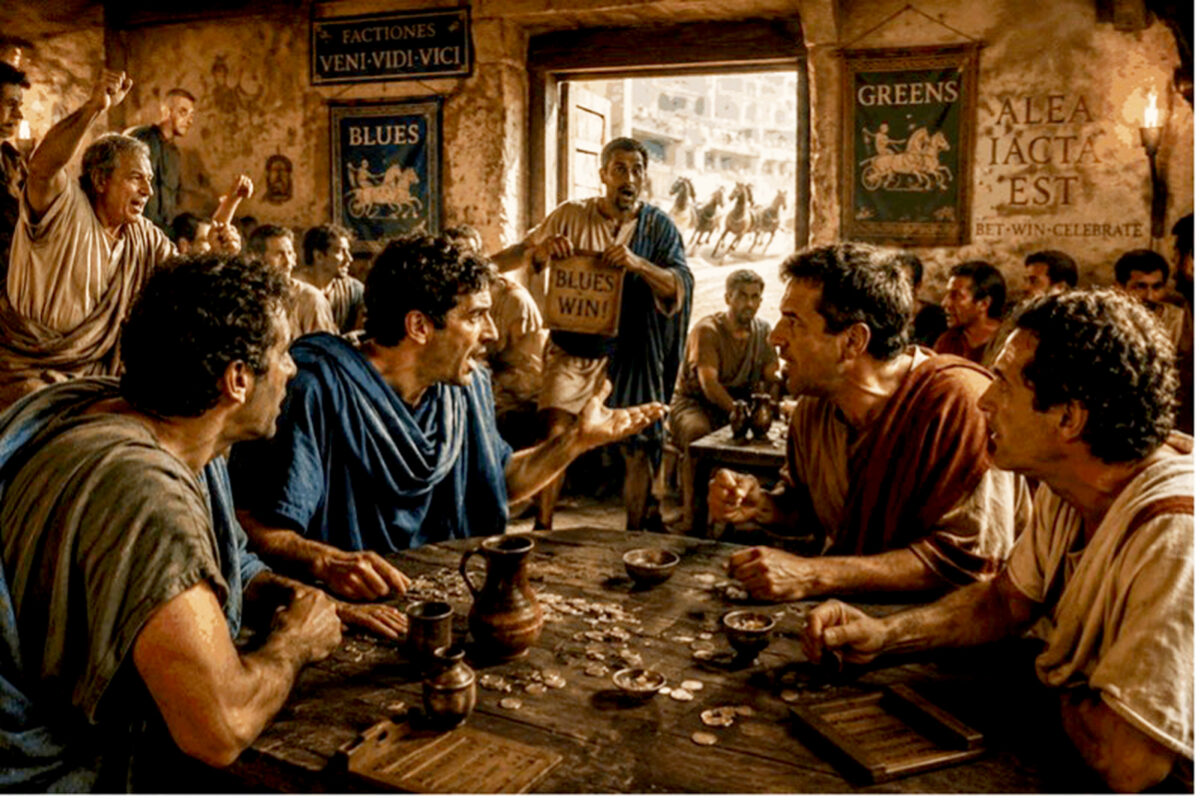
On race days, the Circus Maximus hosted crowds that rivaled the biggest sporting events of our era. Imagine Ohio State versus Michigan, except the rivalry lasted centuries. Romans packed the grandstands dressed in faction colors, shouting for the Blues or Greens as if the fate of the Empire depended on the next turn.
How did the Romans handle gambling on the horse races?
Enthusiastically.
Gambling on chariot racing in ancient Rome was widespread, popular, and deeply woven into the culture. Spectators wagered on the great factions: the Blues, Greens, Reds, and Whites. Those unable to attend likely found their own informal ways to wager a few denarii on the outcome. They wagered on famous drivers, on horses, and on rivalries. If there was a race, somebody was betting on it.
What the Romans did not have was an army of regulators, commissions, auditors, tax collectors, and computer systems tracking every dollar. Roman gambling existed in a world of nods and winks. The government tolerated it. Emperors occasionally participated in it. The wagers flowed freely, and the Circus Maximus remained the center of Roman entertainment for centuries.
Gambling happened; it always seems to happen. But gambling was never the engine of Roman racing. It just put the whole racing scene on steroids.
The Romans would ask us a simple question: Why did you make the bet more important than the race? We built sophisticated wagering systems, advance-deposit wagering, computer algorithms, rebates, and sportsbooks. Yet we neglected the thing they considered most important – fanatic passion.
What we can learn from the chariot races is not that gambling is bad; it is that gambling grows more powerful when fueled by loyalty, rivalry, and belonging. In Roman times, the wager was never the show. The wager just made the show louder.
But without regulated gambling, who staged the races, and why? The presenters of Roman races were often political. An emperor, or a man hoping to become one, understood the value of keeping the masses happy and occupied. Putting on a damn good show at the Circus Maximus was a powerful tool.
For many Romans, faction loyalty was not a race-day hobby. It was part of daily life. That sense of belonging is the secret ingredient modern harness racing seems to overlook. Those of us who participate in the sport know how intriguing and immersive racing can be. Today, racing asks new fans and new gamblers to care about a race. The Romans asked them to care about a team.
That’s a big difference.
Nobody asks a Browns fan why he cares, but he does. Browns fans may never place a wager, yet they passionately follow the home team, player acquisitions, front-office maneuvers, and every other facet of the franchise. Ancient racing fans were similarly passionate about their factions, and the gambling followed, long before legal sportsbooks appeared on every commercial break.
The Romans understood this concept two thousand years ago. Wagering followed loyalty. A Green faction supporter remained a Green faction supporter. Wagers or not, they celebrated victories. They argued with rival fans. They followed the drivers. They discussed racing endlessly.
The Romans enjoyed a huge advantage: chariot racing was the top dog in their sporting world. For a time, modern harness horse racing enjoyed an advantage of its own. Legal gambling was scarce, and racetracks had much of the market to themselves. That comfortable window is closing fast. Today, wagering is everywhere, and harness racing competes for the gambling dollar against casinos, lotteries, sportsbooks, online platforms, and games available on a phone at the kitchen table.
The Romans would likely attack our modern problem by leaning into something the rest of the sporting world still understands: People follow people. People follow stories. People follow teams. Then they gamble.
That is why I continue to believe that some form of team competition could strengthen modern harness racing. The idea does not require changing the sport. It does not require new racetracks. It does not require new horses. It requires new reasons to care.
What if harness racing minimized gambling in its quest to recruit a new generation? What if harness racing stopped viewing gambling as its primary product? What if the product became more communal? Imagine 10 private stables competing under their own banners. Fans choosing sides. Rivalries developing. Stories spreading. Gambling might still exist in the background, but it would no longer carry the entire weight of the sport.
Perhaps the greatest lesson from Roman gambling is that gambling itself was never enough.
The crowds did not flock to the Circus Maximus because they wanted to wager. They came for the factions, the rivalries, the personalities, and the stories. The Romans built the greatest racing spectacle in history on involvement, not betting.
Perhaps it is time to put the horse before the cart of gambling.
Stay on top of all harness racing news.
Join the HRU mailing list, free.