






Harness ghosts of the past
by Trey Nosrac
As usual, I was under a misconception. A 2 a.m. rabbit hole led to the true story. You might find it of interest.
Many of us were napping or reading our racing programs during history classes about the Roman Empire. Since I was not paying attention, I did not realize that the Roman Colosseum and the Circus Maximus were completely different structures, from completely different eras, with completely different purposes.
The Colosseum, also known as the Flavian Amphitheatre, was built around 70–80 AD. This is the place we usually think about when we think of the actor Russell Crowe and the Gladiator fights. The Colosseum also specialized in staging animal hunts, public spectacles, a steady diet of public executions, and staging mock battles in an oval amphitheater that sat roughly 50,000–70,000 people.
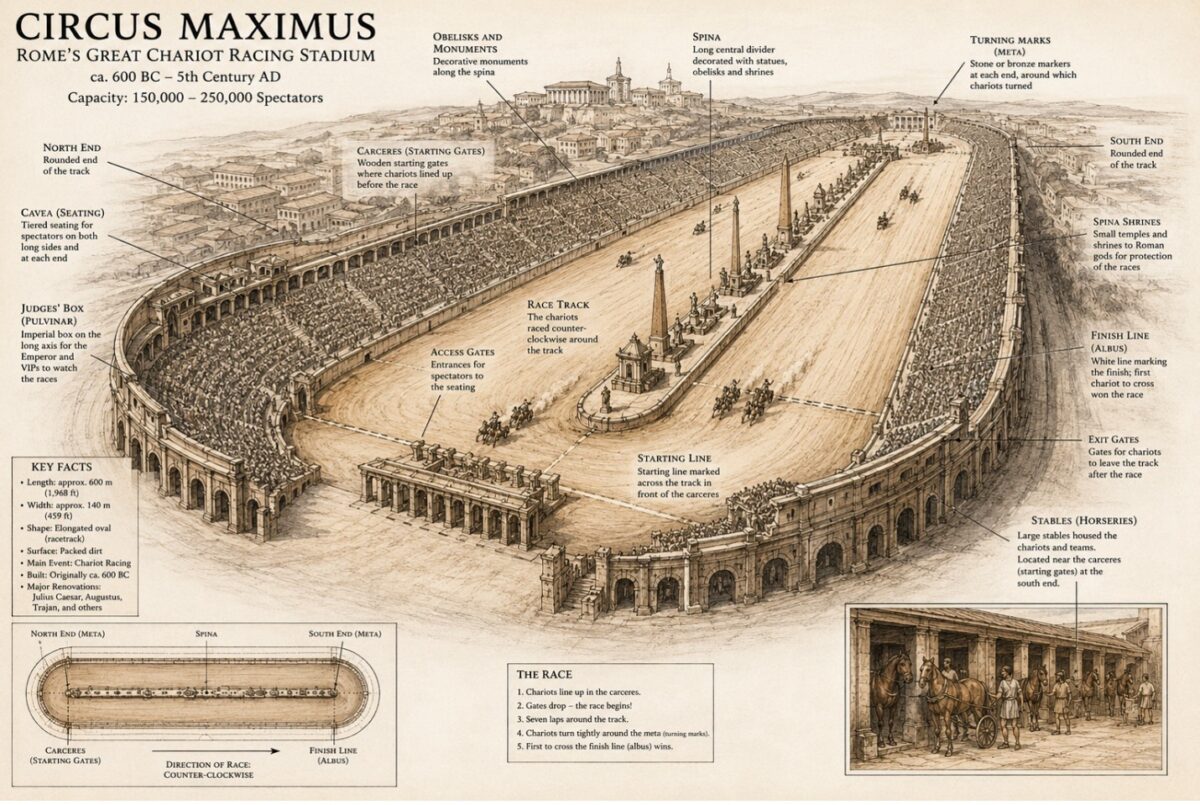
Six hundred years before the Colosseum, the Circus Maximus was rocking. In ancient Rome, the word circus did not have the same meaning as today, with clowns, tents, and cotton candy. Nor did it refer to the Cirque du Soleil with bizarre acts, music, and strobe lighting. In ancient Rome, the word circus referred to a large oval racetrack used for chariot racing.
A Roman hearing “Circus Maximus” would have understood it as “The Grandest Racing Venue in the Empire.” The Circus Maximus was a racetrack for chariot racing and was huge. How Huge? Close your eyes and picture the Ohio State football stadium, then add the Michigan State football stadium, then add a few more stadiums. This massive place was built for racing horses; horses that were fast, dangerous, political, and wildly popular.
The Circus Maximus was a racetrack with famous drivers, favored horses, fanatic fans, gambling, rivalries, wealthy horse owners, and the occasional riot. These Ancient Roman chariot drivers were closer to modern harness racing stars; they were not gladiators. One driver, Gaius Appuleius Diocles, reportedly earned an amount that historians estimate would equal hundreds of millions of dollars today. He raced for different “teams” identified by colors that resembled modern sports franchises.
The Romans packed the Circus Maximus to watch chariots pulled by teams of horses thunder around a long oval track divided by a center barrier called the spina. Fans wore the colors of racing factions the way modern fans wear Dodgers or Buckeyes gear. The major stables were organized into teams identified by colors: Blues, Greens, Reds, and Whites. Entire sections of society emotionally attached themselves to these teams.
The similarities become even stranger when you dig deeper. Roman fans followed the breeding and acquisition of horses the way modern horsemen follow yearling sales. Successful stables spent heavily to acquire the best horses and drivers. Wealthy patrons funded teams seeking prestige as much as profit.
Roman chariot races typically involved seven laps around the track. Spectators kept track of laps using large markers on the spina (spine or center divider), much like modern fans watching fractions and progress around the oval. Post positions mattered. Race strategy mattered. Drivers fought for position heading into the turns. Getting pinned behind a fading rival could ruin a race. A clean trip could make a hero. A bad trip could trigger arguments that lasted until the next race day.
The Romans debated drivers, horses, and racing strategy endlessly. There were scandals involving fixed races, political favoritism, and accusations of corruption. Fans screamed at officials. They worshipped certain horses. They blamed losses on bad trips.
It appears people have been yelling, “You pulled too soon!” or, “Why in the hell didn’t he pull?” for about 2,000 years.
One aspect the Romans understood and capitalized on was that racing was not merely gambling. It was identity, belonging, tribal, and emotional. Many Romans identified themselves first as Blues, Greens, Reds, or Whites. Some fans inherited their allegiance from their parents. They stayed loyal through losing seasons, controversial officials, and disappointing performances. Fans of the Circus Maximus behaved just like modern sports fans and owners.
We have spent a century, the length of our little sliver of history, under the impression that wagering is the only possible economic engine for the sport. The Romans were packing a quarter-million-seat facility to watch horses pull vehicles with people driving, long before casinos, simulcasting, or ADWs existed. People may have wagered a few Aureus (gold coins), Denarius (silver coins), and Sestertius (brass coins) among themselves, but they came because they were emotionally invested in the competition and the experience. They wanted to belong to something strange and slightly magical.
Harness racing still contains nearly all the ingredients that once captivated Rome: speed, a dash of danger, loyalty, strategy, bloodlines, personalities, beautiful horses, rumbling hoofs, and impossible victories. The bones are still there. We need to re-harness them.
A Roman satirist named Juvenal said it best:
“Duas tantum res anxius optat, panem et circenses.”
“The people long eagerly for just two things, bread and circuses.”
Stay on top of all harness racing news.
Join the HRU mailing list, free.