





Farms may hold the key to our future
by Trey Nosrac
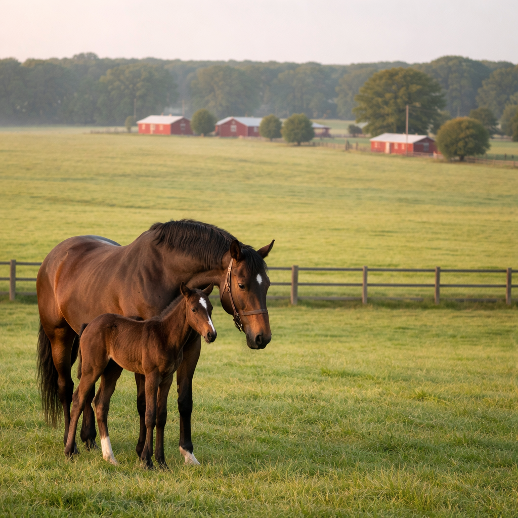
My ex-roommate, former brother-in-law, and current horse partner, Xavier Williams, steered his Subaru through dancing snowflakes on a Friday morning in March. I rode shotgun. Our destination was central Ohio to visit our broodmare and the filly she had foaled two nights earlier.
He turned down the Dylan mix, muting one of my favorites, Slow Train Coming, and said,
“I read your post about buying slightly used harness horses for resale, then racing them in some kind of private setup.”
“I’m totally aware the idea is radical,” I said, “but this sport needs to make some serious adjustments.”
“Sure,” he said, “but I see a problem. We’re driving straight toward it right now – breeding farms. They make the horses. The farms and yearling sales are the engine that keeps the business going. Your idea about racing used or marginal horses isn’t going to pay their bills.”
I nodded. “Exactly. Buying, selling, the auctions, and raising yearlings are my favorite parts of harness racing. Breeding farms have our best business minds, and they’re motivated to create a product customers will actually purchase. They should be holding the reins of this sport from start to finish.”
“Then why push the used-horse angle?”
“That example was simply for speed and proof-of-concept. I was looking for a pool of horses that could be bought and resold quickly for a beta test. I could have used claimers — or even horses headed for the meat market. The point of my early madness was to demonstrate that a private racing program is both legal and feasible. Eventually and ideally, that pool would be yearlings bred specifically for private competition.”
“That’s a pretty ambitious goal for a farm,” Xavier said.
“Think about it this way. Suppose we start a breeding farm that stands two trotting stallions.”
“Okay.”
“Our goal is to produce 250 yearlings from those two stallions, some on our farm, some from outside broodmare owners who buy into the idea. Every one of them goes to a single private auction.”
“What about state programs? Eligibility? Grand Circuit? Dual eligibility?”
“None of the above. We’re not looking to compete with the current system we’re building a new one. We find states willing to work with a non-gambling model. Mares bred to our stallions race in a closed, private program. The only world that matters is the one built around those stallions and their offspring.”
He slowed for a stop sign. “You’re asking farms to make a long-term investment and create a racing environment for customers.”
“Exactly. There are advantages to a smaller pool. You don’t need the fastest trotter in North America to make money. Right now, farms sell hope, but buyers feel like they’re up against overwhelming numbers. This flips that. The farm controls the product, the racing environment, the care, and the rewards. It’s pro-breeder but also pro-customer.”
Xavier smiled. “I liked your idea about keeping all the horses at one facility, hiring trainers employed by the farm. Fewer shipping costs, better oversight, more consistency. No starting fees, no chasing casino subsidies or legislative decisions. But where does the money come from for the participants?”
“A portion of the purchase price goes into the reward pool. Add membership dues and revenue from on-site businesses – restaurants, lodging, events. The key is this: we offer a competitive rewards structure, but with a fraction of the horses competing. If your odds improve that much, how much more would you be willing to bid on a yearling? That’s the real equation.”
Xavier didn’t reply. I kept going.
“I’ve been doing some back-of-the-envelope math. Let’s use the 2-year-old we have in training as an example. If 25 per cent of the sale price was earmarked for the rewards pool, and you took the $6,000 we’ve already spent this year on traditional staking, then added a $2,000 club membership, you’re at roughly $20,000 per horse going into the pool. Multiply that by 200 horses, and you have a reward pool of $4 million.”
“But you can’t be a world champion in a closed system,” Xavier said.
“Maybe, maybe not,” I said. “It would probably be wise to have a path if a horse in this private pool turns into a superhorse. Our rule is simple – you can’t enter the private pool, but you can leave it.”
He turned into the farm driveway.
I tried to sum it up. “Instead of farms selling yearlings and waving goodbye, they sell leases and become long-term partners in the racing product. They keep a small equity stake in each horse. Additional revenue feeds the reward pool. If the environment is consistent, understandable, and fair, buyers who enjoy the experience will return. The only mystery is which horses turn out to be good.”
Xavier shook his head. “That’s a lot of moving parts.”
“No doubt,” I said. “Farms that stand stallions would essentially be underwriting a league with clear rules and a defined customer experience.”
He tapped the steering wheel. “You’re talking about vertical integration.”
“I’m talking about survival and getting ahead of a potential gambling decline by creating a parallel competition model with its own reward system. Farms already control genetics, marketing, and customer relationships. They’ve earned trust. The next step is offering structured competition as part of the package.”
The snow fell harder as we pulled in. Broodmares with foals at their sides stood with their backs to the wind. Xavier shut off the engine.
“Still sounds like a gamble,” he said.
“Everything in this sport is a gamble,” I told him. “The goal is a modest, attainable profit for customers along with controlled expenses and a better experience.
“Breeding farms may steady harness racing. They may be the link between the sport of yesterday and tomorrow.”
Stay on top of all harness racing news.
Join the HRU mailing list, free.