






Yearly blood work saved George Brennan’slife
by Debbie Little
Thanks to an annual physical, driver George Brennan is on the road to recovery following major surgery.
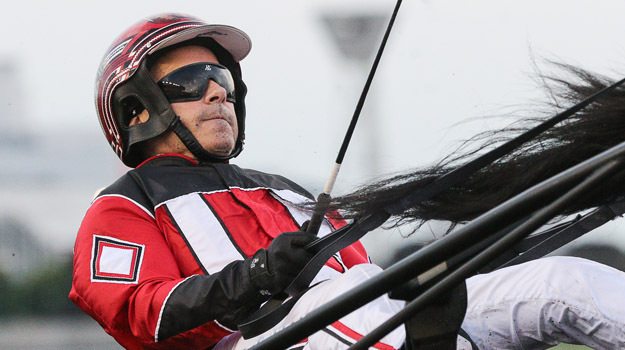
Brennan, 58, who was last seen in action at Yonkers Raceway on Friday (March 6), expects to be back on the track by the end of April despite having a life-saving procedure on March 17.
“They took out my prostate,” Brennan said.
He went on to say that he’s been getting yearly exams since his late 20s, which eventually included a prostate-specific antigen (PSA) test. A high PSA level can be a sign of prostate cancer. According to the Cleveland Clinic website, if men aged 50 to 60 have a PSA higher than 3.5 nanograms per milliliter of blood it is considered abnormal.
Over the last few years, Brennan’s PSA number started to rise higher than what they’d like for his age, which triggered the necessity of a biopsy.
“It came back where I had a speck of a tumor,” Brennan said. “And when I say a speck, it was the size of a millimeter. So, at that point, my doctor said, ‘Well, we’ve just got to monitor it, and we’ll take your PSA every three months.’ And we did. And one time it went down, stayed about the same, and then last year it went back up to almost 6.8, so they ordered an MRI, and then another biopsy, and that’s when they found two more little tumors bigger than a millimeter. So now there are three in there, cancerous.”

Brennan said his doctor was clear about what he thought the next move should be.
“He recommended taking it out, because he said, at my age, I’m too young; I don’t hear that that much anymore,” Brennan said with a laugh. “He said I was too young for any treatment. He said if he gave me radiation, 10 years from now, I could get complications from that radiation. So, he recommended just take it out.”
HRU caught up with Brennan 11 days after his surgery while he was taking his daily walk through his neighborhood.
He returned home the day after his operation under the watchful eyes of his “own private nurses,” his daughters, Natalie and Mackenzie.
His youngest daughter, Mackenzie, who actually is a nurse, was immediately impressed by how well he was doing.
“So, I’m sitting in the living room on Thursday [March 19, two days after the surgery], and Mackenzie says, ‘Dad, I can’t believe you just had surgery, you look so good coming out of it,’” George said.
As for his return to the track, he said, “I’m pretty sure the cancer is out of me now, and my body will let me know when it’s time to come back. Of course, I’d like to be there [at Yonkers for the early legs of the McIntyre and Borgata], but Mike Lachance called me and told me, ‘Don’t rush it. Whatever you do, don’t rush it.’
“The paper I got [from the hospital] said, ‘Don’t do anything strenuous for six weeks.’ But I’m not buying that. I’ll be good before six weeks. I’m thinking, right around my birthday, April 20.”
Even though he may return to the races for his 59th birthday, George doesn’t plan to go full-tilt boogie.
“It’s not like I’m going to tell the judges I’m good for every race,” he said. “I’ll call up my contacts and just say, ‘Maybe just put me on a couple and I’ll handle that, and see how it feels.’”
According to medical websites, prostate cancer is the most common non-skin cancer found in men and symptoms don’t usually occur until later stages of the disease.
“In my case, my prostate wasn’t enlarged, it wasn’t displaced, and I never got up during the night to pee, so I had no symptoms whatsoever,” he said. “And who knows, it might have been too late [by the time I had symptoms]. You know, the tumors could have been the size of an orange by then. Who knows?”
George has a little time before any sort of follow up with his doctors.
“I’ve got to get a blood test taken the first week of June to see where my PSA is at,” he said. “But the one thing about the cancer that I had, it stayed in the prostate, it didn’t go out of the prostate, which was good.
“It could have moved to the bladder, it could have moved here, there, but no, it just stayed isolated in the prostate. And now the prostate is out, so the cancer should be out.
“It’s very common. You know the actor, Ben Stiller? He had his taken out at 48 and Bo Jackson just had his taken out. He’s 63.”
Stiller, 60, is now an advocate for both early prostate cancer screening and PSA testing. If he ever wanted a top-level harness driver alongside him spreading the word, George would certainly be willing to do a PSA (Public Service Announcement) about PSAs, which he thinks men should start getting in their mid-40s.
“Chris Height texted me last week, and he’s about the same age as me, and I said, ‘Height, go get a PSA test,’” George said. “He said, ‘I’m on it right now.’ I said, ‘Well, good for you.’
“It doesn’t hurt [to get a PSA test] and if it comes back and everything’s negative, it puts your mind at ease.”
Stay on top of all harness racing news.
Join the HRU mailing list, free.