







Why are female drivers regarded differently Down Under?
As opposed to the U.S., female drivers are commonplace in Australia.
by Adam Hamilton
It is a tale of two hemispheres.
Young Australian Tamsyn Potter’s recent working holiday in the U.S. underlined the difference in perception and opportunities for female drivers compared to her homeland.
Females driving at the biggest meetings, in the marquee races and on some of the best horses is very much the norm in Australia now.
What a change from 50 years ago when not a single female held a harness racing driving license in Australia.
Now women are major players in every state.
Former Aussie and now U.S.-based Lauren Tritton touched on this when reflecting on Potter’s U.S. stint.
“In Australia, female drivers are thrown in the deep end and it’s sink or swim,” Tritton said. “Over here, I still hear comments like ‘You’re a pretty good driver for a woman,’ and I’m trying to change that.

“So, to see the Aussie girls [Potter and Shannon O’Sullivan] come over and put on a show was really pleasing.”
Tritton herself has been a remarkable success story since making the U.S. home with husband, Shane, six years ago. And that’s while juggling two kids, Levi and Emily.
Not only was she the leading money-winning female driver in the U.S. last year ($550,199) but she and another former Aussie, the Canadian-based Natasha Day, were second and third to Marie-Claude Auger as the most successful female drivers in North America.
Like most Aussies, Lauren started young, driving in Group 1 Grand Circuit races at just 17. She drove 920 winners in Australia and won a NSW Drivers’ Premiership at just 22 before moving to the U.S. three years later.
Lauren emerged at a golden time for female drivers in Australia with so many trailblazers to thank before her.
None more so than the remarkable Kerryn Manning.
Manning, daughter of highly respected horseman Peter Manning, was a gifted talent from day one, but really rose to prominence in the late 1990s when she teamed with her dad’s mighty trotter Knight Pistol.
When Knight Pistol won the 1997 Harley Davidson Trot in Norway, Kerryn became just the second female to drive a European Group 1 winner.

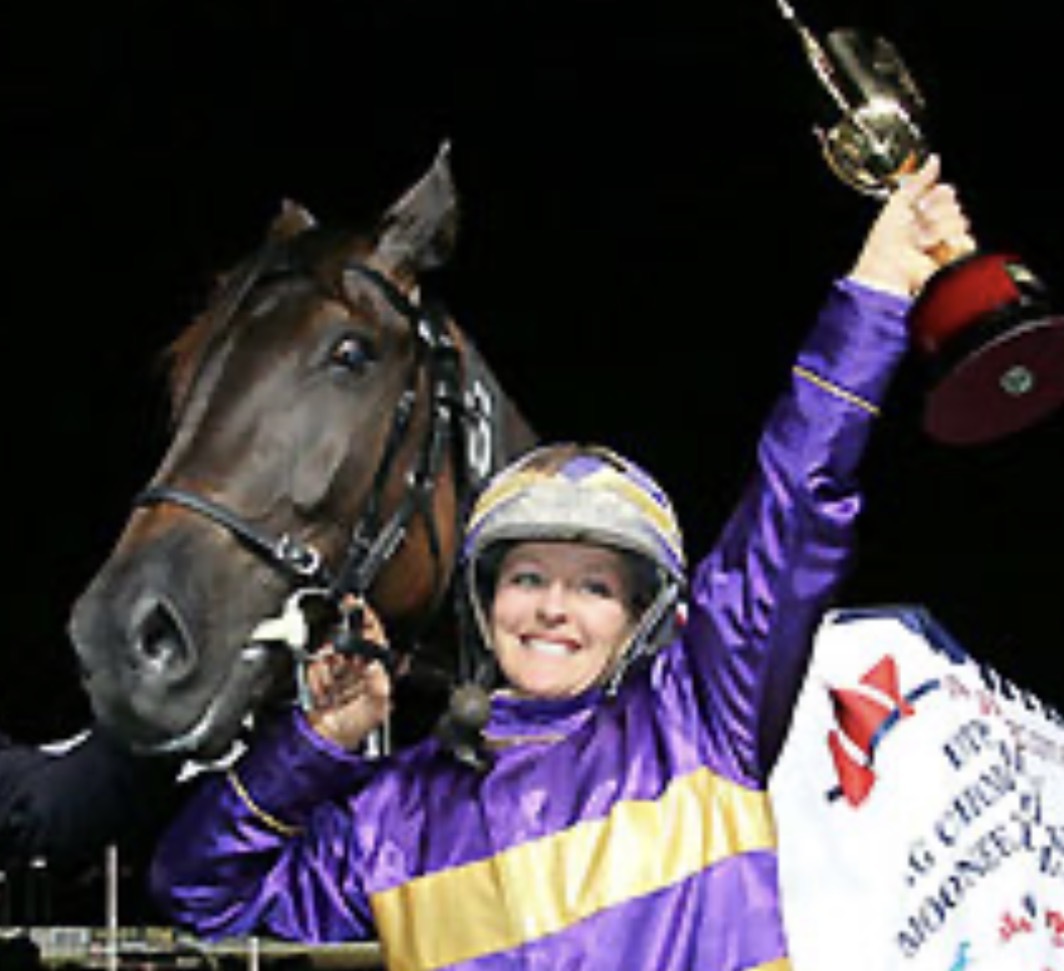
Oh, what was to follow.
Four Australian Driving Premierships, upstaging a stellar group of men, an Australasian record 18 seasons with 100 wins or more and countless major wins.
None bigger than becoming the first female to drive the winner of the iconic New Zealand Trotting Cup in 2015.
Kerryn boasts almost 4,500 career wins, by far the most by a female anywhere in the world; 43 of those have been at Group 1 level.
She is streets ahead of the next best, another Aussie, the unsung 60-year-old Lola Weidemann, with almost 3,200 wins.
Let this sink in… of the 42 females to drive more than 100 winners in a season at least once, 30 of those have been Australian.
Other headline acts have been Amanda Turnbull (14 seasons of 100 or more wins), while Jodi Quinlan, Weidemann, and Dani Hill have done it 11 times.
Turnbull, Quinlan, Hill, and Kate Gath are all still driving and well past 2,000 career wins.
Outside of Australia, only Canada’s Mary McDonald and Germany’s Rita Drees have topped
2,000 wins.
But it hasn’t always been an Aussie dominance.
Australian harness historian John Peck cites Bea Farber’s visit to Australia in 1979 to contest the World Driving Championship as an important moment.
“She drove a winner at Moonee Valley and people really took notice,” he said. “The big question is why are females such a huge part of the driving ranks in Australia?
“The elevation of Graeme Cochran to the Trotting Control Board (now Harness Racing Victoria) and the Australian Trotting Council (now Harness Racing Australia), which coincided with all the necessary rule changes and that World Driving Championship, was not insignificant.
“That said, the sheer unbridled passion of the pioneer State Women’s Associations to gain acceptance coupled with the power of their family support networks represented an unstoppable force.

“Crowning it all on the world stage was Kerryn becoming only the second woman to win a European Grand Circuit race and then surpassing the world record of Drees.
“Much later, the growth of the pony trots [kids driving in pony races at harness meetings], also brought forth some real talent, most notably someone like Ellen Tormey [who now boasts over 1,300 wins]. The runaway success of the Teal promotion was perfectly timed as the revolution was well underway.
“I think it’s just the most amazing story, not just here, but seeing what Lauren [Tritton] and Natasha [Day] are doing in North America, too.”
While Kerryn has been the trailblazer, so many others have played crucial roles.
Margaret Frost, then wife of the Hall of Famer Vic Frost, was the first woman to drive a winner at Harold Park, an iconic track and the long-time home of NSW harness racing. She was also the first female to drive a winner in faster than a 2:00 minute mile rate.
Margaret’s credits also included being the first female to win a race during an Inter Dominion series when she won the 1981 consolation on Grand Thor at Harold Park.
A few years later, Victoria’s Anne Frawley was the first female driver to win an Australian Group 1 race on Vanderport in the 1985 New South Wales Derby. The next year she drove the same pacer to finish second to Village Kid in the Brisbane Inter Dominion final.
Kellie Kersley became the first female to drive a Miracle Mile winner on Norms Daughter in 1995 and then Quinlan did the same on Sokyola in 2004.
Gath won almost every major race that matters and three Victorian Metropolitan Driver titles, along with Turnbull’s years of dominance in NSW.
Natalie Rasmussen arguably played as big a role as any, propelled through her profile as trainer/driver of the great Blacks A Fake, who is in talks with Leap To Fame as Australia’s all-time greatest pacer.
Although Rasmussen did so much more than that, especially during her time in partnership with Mark Purdon winning loads of major races on star horses, the Blacks A Fake union was special.
The best horse in the sport for about five years was not just trained, but also driven by a female.
As the astute media man of the time, Bill Hutchison, so accurately said: “Nat has driven him over 100 times, and in the biggest races in the game, and given him a great trip every time.
“Despite all the pressure that went with him, she just took it in her stride and delivered great drives, big race after big races, year after year.”
A tale of two hemispheres has been flipped on its head courtesy of a “zero to hero” Down Under revolution.
Stay on top of all harness racing news.
Join the HRU mailing list, free.