


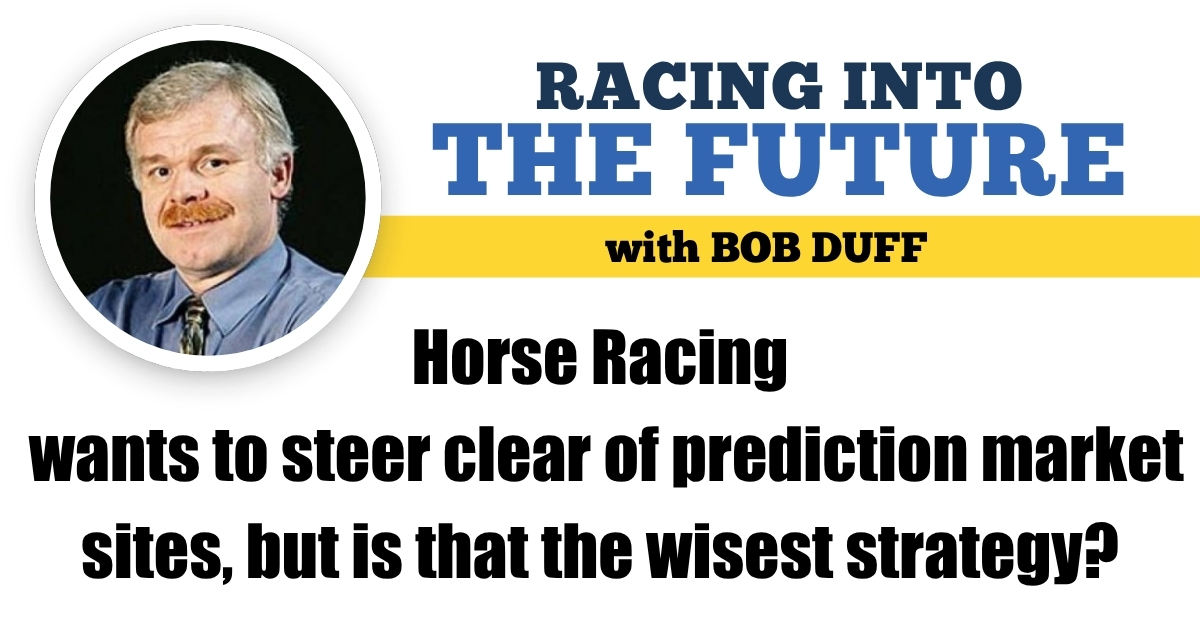


Horse Racing wants to steer clear of prediction market sites, but is that the wisest strategy?
by Bob Duff
Prediction markets are everywhere in the news when it comes to the sports betting industry. Falling into a gray area in which they are basically able to offer people sports betting without it being classified as sports betting, sites such as Kalshi and Polymarket are utilizing this loophole to operate within virtually every U.S. state, including those that haven’t opted to legalize sports betting.
To date, though, these prediction market sites have stayed away from entering the horse racing prediction game for the most part.
Why? Well, there appears to be more than one reason why prediction markets haven’t found a market for horse racing.
First of all, the sports event contracts offered by prediction market sites tend to be an either/or option. For instance, in football, you can choose to back a yes or no option on whether the Kansas City Chiefs will win the Super Bowl in the next NFL season.
Even in game markets, the majority of sports offer a player two options when it comes to outcomes. Yes, the New York Yankees will beat the Boston Red. Or no, it’s the Red Sox who will beat the Yankees.
Horse racing can have 10 or more entries in a race. Turning this into a yes or no option provided by a sports event contract would prove more complicated. Still, the prediction market sites have come up with event contracts on multi-participant sports such as golf or tennis, so it’s not beyond the realm of possibility.
So why not horse racing then? Well, because the scenario is more complicated from a legal standpoint than traditional sports betting.
PREDICTION MARKETS FIGHTING IN COURT
Several states that offer legal and regulated sports betting are currently engaged in court battles with prediction market sites, seeking to have them banned from operating in the state.
The stumbling block, or the loophole in use, if you will, is that prediction markets are regulated by the Commodity Futures Trading Commission, which is a federal entity. Sports betting sites operating in the U.S. market are all regulated by state governments.
Lawyers representing the prediction market sites argue that a state law can’t override a federal law. However, that argument isn’t going to fly when it comes to horse racing.
Horse racing is ruled by the Interstate Horseracing Act (IHA), which is also a federal law. This statute gives the horse racing industry control of where its product can be offered for wagering.
The majority of sports betting sites in the U.S. market don’t offer horse racing wagering on their sites because of this fact. In a few states, there have been some agreements between sports betting operators and horse racing officials to carry wagering on horse racing, but it’s very limited in scope.
Leaders in the horse racing industry are ready to go to court and fight it out with the prediction market sites if they attempt to enter into the horse racing game.
Bill Carstanjen, CEO of Churchill Downs, pointed this fact out during a recent earnings call with investors. And he further noted that his powerful company, operators of the Kentucky Derby as well as Twin Spires, one of the leading advance deposit wagering services in the U.S., won’t allow any prediction market site to offer sports event contracts on the Kentucky Derby.
“Horse racing has a different legal paradigm than other sports offerings in the United States,” Carstanjen said. “Pari-mutuel wagering on horse racing is conducted under the Interstate Horseracing Act, which is a federal umbrella statute that essentially gives us a series of rights — call them intellectual property rights — in our content.”
Polymarket reportedly handled $1.2 million in event contracts on last year’s Kentucky Derby. If it or any other prediction market site tries to go there for the 2026 race, Carstanjen is prepared to shut them down.
“To take wagers across any forum, whether it be a sports wagering platform, another horse racing platform, or a prediction markets platform, you need our express consent,” Carstanjen said. “You can’t just do it without that.
“We haven’t agreed to provide our content to prediction markets.”
Interestingly, Twin Spires was able to use the reverse of this argument to win the right to offer ADW wagering in Michigan, even though state law there read that ADW could only be offered in conjunction with live racing. Michigan currently has no live racing product.
However, lawyers representing Twin Spires successfully argued that Michigan’s state law couldn’t override the federal IHA.
If prediction markets want to get into offering event contracts on horse racing, they’d better be prepared to negotiate with the racetrack operators. If they try to go ahead similarly to other sports, they can expect to hear from lawyers representing the horse racing industry.
“Prediction markets are not a part of the current mutual wagering on horse racing, nor would I expect them to be any time in the future,” Carstanjen said.
OTHER INDUSTRY ANALYSTS BELIEVE HORSE RACING SHOULD ENGAGE WITH PREDICTION MARKETS
There are others in the industry who believe that it would be wiser for horse racing to engage with the prediction market operators and find common ground.
One of those holding this opinion is Michele Fischer, a wagering consultant and vice president of SIS Content Services.
“We missed the mark with sports betting for the horse-racing industry,” Fischer said while speaking at the recent national HBPA conference at Oaklawn Park. “It’s a highly regulated form of gambling, and that’s something that’s still on the table for horse racing.”
Rather than viewing prediction markets as a threat, Fischer believes that it would be wiser to try to negotiate and see if there’s an avenue there to grow the sport.
“I think that the conversation needs to be a little wider,” Fischer said. “We sit here and look at all the threats, which they all can be. But where are those opportunities for this new market we’ve been talking about for 20 years?
“Where are all the eyeballs that we wanted on horse racing? What are they watching?”
Stay on top of all harness racing news.
Join the HRU mailing list, free.