




Kleinhans launches Pick-8 bet at The Meadowlands, seeding it with $50,000 of his own money
The wager has already been tweaked after its debut, but whether it, ultimately, turns out to be a boom or a bust, it’s something worth trying.
by Brett Sturman
To a decent amount of industry fanfare this week, Friday’s (Jan. 6) card at the Meadowlands debuted a new Pick-8, known as the PK-8, wager courtesy of well-known and multi-faceted industry participant Peter Kleinhans. What makes this PK-8 wager unique from any other multi-leg Pick-X wager in the sport, is that this one comes seeded with $50,000 already committed to the pool.
However, that free money to shoot for comes with a high-level degree of difficulty. The PK-8 wager comes with a $1 minimum base, which could be a culture shock to many who have become accustomed to smaller Meadowlands denominations such as a $0.50 Pick-4, a $0.20 Pick-6, or even just the way in general the industry has moved to the lowest possible wagering denominations.
But when you put those two components together — a high-seeded amount and a wagering minimum that promotes pool carryovers — what you end up with is a wager where if hit, could produce five, six, or maybe even a seven-digit payout if the pool becomes high enough.
Kleinhans, who developed the wager, said he thought hard about the price point to enter.
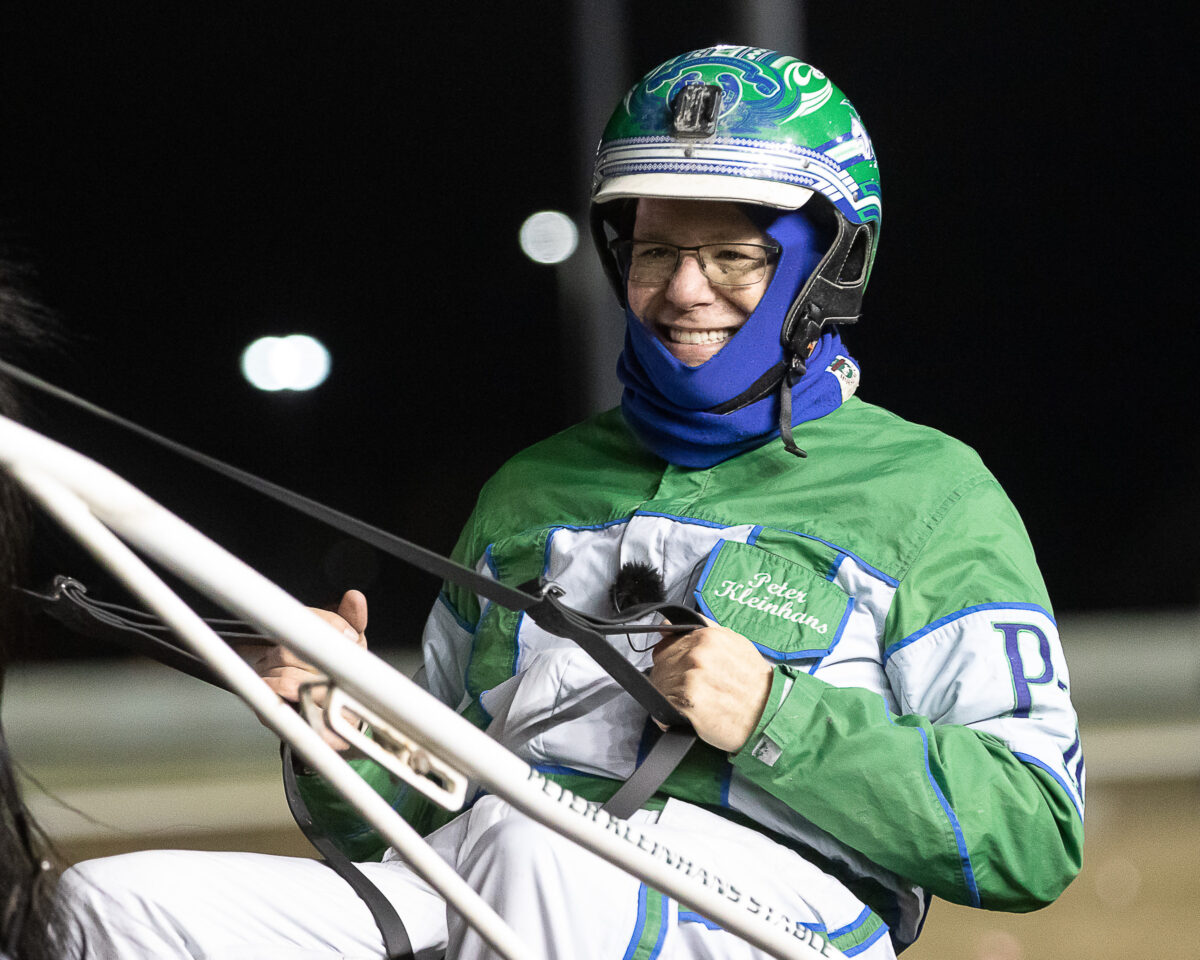
“My big question was should it be $1 or should it be $0.50, and I went back and forth asking all the bettors and people I knew, and we ended up concluding that $1 made sense to start with,” Kleinhans said. “Because if it starts at $0.50 and it’s too easy then I get crushed and the entire thing could be over. But if it’s too hard at $1, you can always back it down to $0.50 later. But the only way to find out is to just do it and see how much interest there is for that many races at that price point.”
For as challenging as you’d think the sequence would be to hit based on the parameters, it was amazingly almost hit in its debut on Friday night. Winners over the eight-race wager included a $17 winner in the MADC opening leg followed immediately by a $13 winner. Later, there was an $11.60 winner and the sequence concluded with a $19.40 winner. That’s wildly impressive considering the challenging sequence and the relatively mild amount that was bet into the pool.
When speaking to Kleinhans prior to Friday races about what his guess was for handle, he said, “If you can get 10 per cent of that day’s carryover and so that it rises 1.1 every time – I’m hoping for more than that but that could be a reasonable rate.”
Which comes back to what the bet handled Friday night. Almost to the dollar of what Kleinhans suggested, $4,998 was bet into what was essentially operated the same way as a $50,000 carryover. So, for someone to have hit seven of eight winners with presumably a relatively smaller ticket shows that the wager isn’t as impossible as some detractors may think. Plus, with the wager paying out a 25 per cent consolation each night to whichever tickets have the most winners, seven out of eight last night returned $13,651 despite only $5,000 of new money.
The $13,651 payout did raise a major question as to whether the payout and carryover structure of the wager functioned as intended. With 25 per cent of the total pool, including the $50,000 seeded amount paid out, the new carryover would further dwindle with each race card.
Meadowlands COO Jason Settlemoir said Saturday morning the wager will be tweaked for this coming week. The seed money will become a true carryover amount and the payout for the tickets with the most correct wagers will receive 25 per cent of the new money wagered, not the total pool. The change is made to allow the carryover to grow if someone doesn’t hit the whole thing with eight correct winners.
History has already proven the wager can work when modeled correctly. Scioto Downs ran a $1 Pick-8 seeded with $25,000 that first began in 2022 and was hit on four different occasions in that first year. One of which hit for over $100,000. Granted, races at The Meadowlands may be less predictable, but there is a recent precedent for such a wager.
Back in the days when The Meadowlands ran a $1 Pick-6 in the early part of the 2000s there were often six-figure carryovers well into the hundreds of thousands, with payouts on occasion being over $100,000. This new wager has the potential to exceed both numbers in terms of carryover size and payout.
The PK-8 might not be for everyone and probably won’t be for harness racing traditionalists, but in today’s age of slot jackpots and 15-leg sports parlays, this is what appeals.
While there is an altruistic nature in Kleinhans’ role with the formation of the wager, there is a business component too. Prior press releases alluded to Kleinhans being able to recoup parts of the $50,000 or even make gains on investment depending on how big the pools become. Kleinhans confirmed that as part of the agreement, he’ll be entitled to percentages of track net profits from the wager, and has committed that if and when the wager is hit, to invest another $50,000 up to four times total.
Kleinhans further noted it was his understanding that if the wager isn’t hit for 25 days, then there would be an automatic payout. I found this interesting because on one hand why cap when the wager is going to be paid out, especially envisioning what the pool total could be after 25 days? But on the other hand, the pool size on a mandatory payout day would be absolutely massive.
That investment fact may be neither here nor there as it pertains to the mechanics of the wager, but it is worth noting because if Kleinhans has even moderate personal success, then that would mean the wager should be a broader industry success too.
“My feeling is that if it doesn’t work then I don’t really know what could,” said Kleinhans. “Whether it be at $1 or if you dropped it to $0.50 or anything else – if it doesn’t work it doesn’t work, but I could still go to my grave knowing I took a shot to try to do something bright for the sport.”
Stay on top of all harness racing news.
Join the HRU mailing list, free.