






Dave and Julie Keyes found Figment is the real thing
by Matthew Lomon
When Dave Keyes and his wife Julie, after a lifetime in the standardbred business, decided it was time to downsize and enter what Dave coined a ‘semi-retirement phase,’ the plan was simple: sell, sell, sell.
“We thought we’d just breed and keep a handful, but we almost sold everything,” said Dave, a 47-year industry veteran.
Among the items put on the market were their broodmare band, led by Camluck mare Mia Seelster, who had spent 16 years with the Keyes before selling last December; their Millgrove, ON, farm which they sold this past April; and, finally, their foals.
Finalizing the latter part of the equation, as Dave said, mostly hinged on the price being right.
While that was the case for some, it certainly was not for Figment – a quirky colt who showed just how quickly plans can change.
“It’s not easy to part with any of them,” Dave said. “I’ve been asked plenty over the years, ‘Why don’t you sell them?’ Some people think you have to sell them, but you don’t have to in this sport.
“We’re dominated by big stables, and there’s a lot of money thrown around, but at this stage of our life, we said, ‘Let’s keep him,’ and we’re having a lot of fun.”
On paper, it’s easy to see why Figment — a winner of five straight and six of his first seven starts for nearly $62,000 in prizes — has been a steady source of joy for the Keyes family.
But what profiles today as a prudent choice, both for its fruits on and off the track, didn’t initially appear that way.
“I sent him to the Shetler family for a while to break him and train him,” said Dave of a then 2-year-old Figment.
“He was a growthy colt, and I can’t remember the exact details they said about him, but it was along the lines of ‘There’s nothing wrong with him, he’s just kind of another horse.’ So, we brought him home.”
Back under Dave’s purview, the green Shadow Play gelding wasn’t asked to do much heavy lifting during what would have been his freshman season.
With the farm now sold and a 3-year-old Figment ready to receive Dave’s undivided attention, the pair began working towards a career in racing.
The early returns were mixed.
“He would train really well one week and the next week, it’d be ‘I don’t know why I’m keeping him,’” Dave said with a laugh. “Julie would tease me that I liked him every second time. Half the time he didn’t care, and that was fine. He was an easy-going horse, but I trained alone so that probably made it tougher for him – he wasn’t really competitive because he was training by himself all the time. When we moved from our farm, he started to catch on a bit but still trained the same way.”
Just as it seemed Figment was making strides, his eccentricities — coupled with the unfamiliar presence of a tractor — again hindered his development.
“At my old farm, I was either driving a horse or a tractor; he never met either one of them,” Dave said. “He was with me on the track, or he was put away.
“One day, at the new facility, I’m jogging on the track, and doesn’t he get spooked badly and upsets the cart, dumps me out, and away he goes on his own. He ended up making it back to the barn and wiping out there. Everybody got there to help, but I wasn’t even back to the barn, trying to run back and meet him.”
Fortunately, the incident didn’t cause any serious injuries, only a few scrapes. However, it still sidelined Figment for more than a month.
Once he recovered and overcame his fear of tractors, Figment — still a “skittish colt” at the time — progressed to his next challenge.
“He showed enough that once I got closer to qualifying speed, I put him with a race bike, and he just started to blossom,” Dave said.
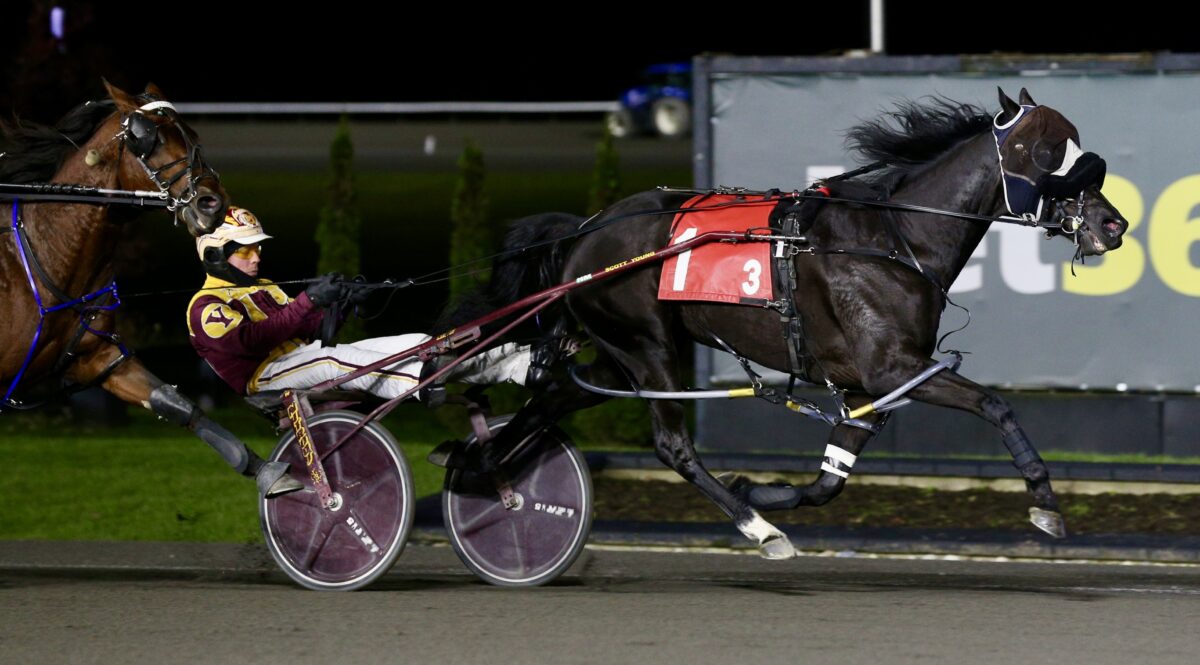
Taking their training sessions to Woodbine Mohawk Park, Dave enlisted the expertise of a familiar face in driver Scott Young.
The son of accomplished horseman and long-time friend of Dave, Bob Young, has eclipsed the $1 million benchmark seven years running.
Dave still did his best to prepare the accomplished reinsman for the full Figment experience.
“Talking to Scott, I said, ‘I think he’s got some talent but be careful first time on the gate,’” Dave said.
A wise piece of advice, indeed.
“He did what I said he did, he jumped four feet sideways,” Dave said. “Luckily, nobody was beside him but once he settled down, Scott was just beside himself with how good he was.”
After a couple more lessons at the Scott Young school of racing, Figment competed in a pair of mid-August qualifiers and hasn’t checked the rearview since.
“He just got better and better and better and this is where we’re at now,” Dave said. “Scott has really done a good job. He’s got experience, he really listened to what I had to say about him and was very excited about the horse right away… After his second or third start, he said, ‘Boy, he’s getting good.’”
The horse, who could very easily have been succeeding for someone else, has instead become the catalyst for Dave’s racing rejuvenation.
“I’ve had a lot of offers on this horse and I’ve entertained none,” Dave said. “I’ve told everybody that things are different now because we sold our farm, and I’m in this semi-retirement phase, that we’re keeping him.
“I have not done a lot of racing in the last 14 years — we used to race more — but we’re having a lot of fun keeping him, so let’s keep him.”
Figment’s impact on the Keyes has been undeniable – so much so that even after all the downsizing and narrowing of his stable, Dave was inspired to add.
“As we said we were winding down, I went out and bought a yearling in London,” he said with a laugh. “I broke my law. I said, ‘I’m going to just play with two,’ because I’m 64 years old, I thought two is a nice number.
“I had four three months ago, and that was too much, so we kept the two we liked the most, and then I got thinking, ‘You know what? From two horses, you can get down to one in a heartbeat’… that’ll be our magic number two or three.”
With a still-maturing Figment as the captain of their stable, Dave and Julie Keyes have everything they need at this stage of their racing lives.
While they may not have envisioned their semi-retirement plan unfolding this way, the Keyes, behind the unexpected success of a peculiar homebred pacer, wouldn’t change a thing.
“We owned his mother for 16 years,” Dave said. “We bought her as a yearling, raced her and had a lot of luck with her. It was fun raising all her foals.
“It adds a lot more enjoyment. You raise them — he was just a little guy — foal them out, and have them as weanlings, yearlings, and spend a couple years trying to get them into the races, and here you are.”
Stay on top of all harness racing news.
Join the HRU mailing list, free.



