







Faster than ever
by Trey Nosrac
An older HRU column by Brett Sturman titled “What is Driving Speed Records” recently caught my eye. A few days after reading the column, I watched my 3-year-old trotting filly race a mile in 1:59. This satisfying event turned slightly depressing when I calculated a 1:49 trotter winning this race would cross the finish line before my filly made the final turn. The performances of racehorses that Sturman highlighted would be science fiction 30 years ago.
Trey began writing about sports during the reign of Lance Armstrong. The American cyclist was a hero for many, a thorn in the side of others. From the beginning of his reign, despite his vehement protestations of innocence and aggressive lawyering, my opinion was that Armstrong and other cyclists were blood doping.
But rumors are not evidence. Eventually, the U.S. Anti-Doping Agency declared Armstrong guilty. On Oprah, he admitted systemic abuse of a drug named erythropoietin to increase red blood cells. Armstrong›s misdeeds and the doping of many other cyclists crawled into the light, but it took a decade, while editors and writers had to bite their pens. Armstrong›s seven Tour de France wins got erased, but the doping stain remained.
The Tour de France winner this year was a Slovenian, Tadej Pogačar. Pogačar is only 26 years old, and this is his fourth consecutive Tour De France triumph. Here is a tidbit to ponder. Performance-wise, the blood-altered Lance Armstrong would be far back in the pack next to Pogačar today. After the tainted past of cycling participants, one’s suspicion radar goes into active mode.
In 2025, there are many more tools and tests than 20 years ago; there may be more of everything, but after scrolling, I found no evidence that Pogačar is doping. Scouring all published sources regarding the famed racer, even AI gives the rider a clean bill.
“As of July 28, 2025, no verified scientific or regulatory evidence exists that Tadej Pogačar has doped. Until proven otherwise, he remains part of a new generation of elite riders under scrutiny and transparency.”
To me, this makes Pogačar’s dominance amazing. I want to believe this guy is legit, but some of our brains can’t help being leery. A segment of people will always be cynical when they witness record performances never before witnessed. The same suspicions hold in horse racing. Another explanation is possible.
There is little doubt that today’s elite humans and animals are bigger, stronger, and faster. Data verifies that the current contestants for the Tour de France podium are speedier and better than ever. Most horse racing people think this overall breed improvement holds for racehorses. But how does a data-driven world of cell phones, solving the human geometric code, Artificial Intelligence, and nuclear biology play into the performance improvements in every sport, including ours?
The past decade has been remarkable on almost every level. How does the new level of human performance in cycling apply to harness horse racing and other sports?
In our sport, we do not appear to go to the extremes that cyclists such as Tadej Pogačar do, which is probably good. Let’s stroll through the preparation and training in the sport of cycling. As we walk, ask yourself if you think this degree of scientific competition would be suitable for our ancient sport? In bicycle racing, there is an astonishing amount of new data and a large army of personnel behind top cyclists.
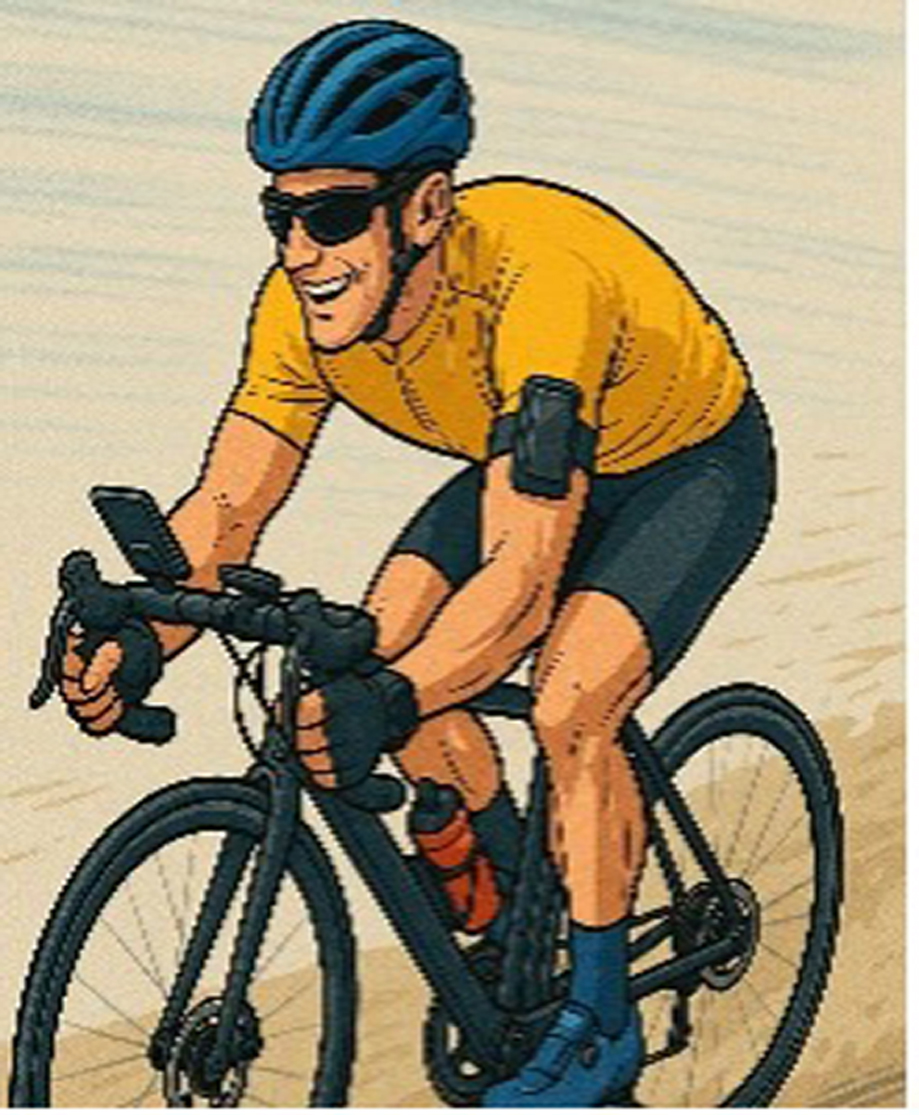
Every rider has a power meter fitted and attached to their bike to understand their numbers in a constant, real-time way, including heart rate, speed, and other measurements.
Riders and their teams publish their data on Strava and similar training apps.
Massive data collection and apps enable humans to live on the edge of their capacities more effectively than they used to.
Cycling has accelerated in the last 20 years because of the evolution of science across many dimensions. New, updated data is available daily.
Highly accurate long-range weather forecasting can predict the wind speed and direction for a given race on a given day and help teams decide how to use aerodynamics: heavier wheels over lighter ones that produce more wind and water resistance.
The improvement in equipment is relentless. A bike is limited to a minimum weight (about 15 pounds). Still, as long as it meets specific regulations of dimension and geometry, its drag coefficient can be wind tunnel–tested to ridiculous degrees.
Everything in bike racing is subject to aerodynamic imperative: the rider’s helmet, jersey, shoes, bikes, wheels, and clothing. Less drag means more speed, and fewer wasted watts maintaining that speed.
Nutrition is off the charts. Riders are fueling in different ways from what they did in the past. Twenty years ago, riders believed that fasting was the way to go. In the past few years, it’s become public knowledge that that is the opposite of what should maximize performance.
Riders know precisely how many grams of food to eat and how often to consume them. They eat energy bars, gels, and follow strict diets using technology that shows on their apps how many grams of which foods are acceptable.
Today’s rising stars generation of cyclists do not know a world where ignoring data and apps is possible; they can’t compete without them.
Everyone is an incrementalist in cycling; the concept is to make 100 tiny changes that add up.
And on and on. The boundaries get pushed for humans and machines. Some of us feel that the more science in sports, the less magic in sports. We want to go back to the good old days. There probably never were the good old days of clean cycling. There probably never were good old days of pristine harness horse racing.
The sporting audience is complicated. Fans look for heroes, they look for villains, and they are always suspicious. Every losing wager has a gambler looking for justification. To counter the raised eyebrows, abnormal athletic gains in performance are attributed to everything from magic to technology, physiology, and mental superiority. Modern gains may also be related to maximizing potential due to sports science.
Doping may still exist in cycling. For example, microdosing with carbon monoxide to mimic the effect of altitude training is a practice recently banned in cycling. Another way to cheat is mechanical doping, with tiny hidden motors placed within the bicycle frame or hub wheel. The policing goes on.
And so it goes. The underbelly of sports has never been pretty. Cheaters cheat, and the innocent suffer. Lines are blurry. Every sport’s technological and data-based improvements thrill some and depress others. Consider Trey depressed for a pair of reasons.
1 — Science is not free. The little guy operating on oats and water will always be disadvantaged.
2 — If Tadej Pogačar is playing fair, the tainted past of previous eras will not allow him to receive the full measure of his due recognition.
Stay on top of all harness racing news.
Join the HRU mailing list, free.



